Cgitems Logo
Entering
Fresco
Loading Encyclopedia...
Connecting to Cgitems Server...
Thanks for your patience
Fresco - CGItems
☆
  • UK - English UK - English
  • France - Français France - Français
  • Germany - Deutsch Germany - Deutsch
  • Netherlands - Nederlands Netherlands - Nederlands
  • Norway - Norsk Norway - Norsk
  • Denmark - Dansk Denmark - Dansk
  • Finland - Suomi Finland - Suomi
  • Vietnam - Tiếng Việt Vietnam - Tiếng Việt
  • Italy - Italiano Italy - Italiano
  • Sweden - Svenska Sweden - Svenska
  • Brazil - Português Brazil - Português
  • Greece - Ελληνικά Greece - Ελληνικά
  • Thailand - ไทย Thailand - ไทย
  • Iran - فارسی Iran - فارسی
  • Arab - العربية Arab - العربية
  • Spain - Español Spain - Español
  • China - 中文 China - 中文
  • Turkey - Türkçe Turkey - Türkçe
  • Russia - Русский Russia - Русский
  • South Korea - 한국어 South Korea - 한국어
  • Japan - 日本語 Japan - 日本語
  • India - हिन्दी India - हिन्दी

Art Movement , Style & Technique

Fresco

SUB CATEGORIES
×

Fresco

Fresco

A comprehensive guide to the visual principles, history, and pioneers of this movement. Curated for researchers and students seeking a structured analysis of artistic styles & Technique .

Available Art Style & Movement

Select Art Style...
  • Abstract
  • Abstract Expressionism
  • Academic Art
  • Aestheticism
  • Architectural Movements
  • Art Deco
  • Art Nouveau
  • Baroque
  • Bauhaus
  • Byzantine
  • Cartoon
  • CGI
  • Chiaroscuro
  • Chiaroscuro Noir
  • Classical Architecture
  • Classicism
  • Comic
  • Conceptual
  • Contemporary
  • Cubism
  • Dada
  • Early Renaissance
  • Expressionism
  • Fantasy Art
  • Fashion
  • Fashion Design
  • Fashion Illustration
  • Fashion Photography
  • Fauvism
  • Fresco
  • Gothic
  • Haute Couture
  • High Renaissance
  • Hybrid
  • Illustration
  • Impressionism
  • Landscape
  • Line art
  • Manga
  • Mannerism
  • Marvel
  • Matte Painting
  • Miniature
  • Minimalism
  • Modern Architecture
  • Modernism
  • Muralism
  • Neoclassicism
  • Orientalism
  • Photography
  • Pop Art
  • Pre-Raphaelite
  • Realism
  • Regionalism
  • Relief 
  • Renaissance
  • Rococo
  • Romanticism
  • SCI-FI
  • Sculpting
  • Street Art
  • Surrealism
  • Symbolism
  • Tempera
  • Tenebrism
  • Tonalism
  • VFX
  • Victorian
General Specifcations for Fresco

Fresco is an ancient and highly durable mural painting technique executed upon freshly laid, or “wet,” lime plaster. The term translates directly from the Italian word for “fresh.” In true fresco (buon fresco), water is used as the binding vehicle for dry-powder pigment. As the plaster dries and sets through a chemical reaction with the air (carbonation), the pigment becomes completely fused with the wall itself, rather than resting on top of it as a surface layer. This integration makes fresco one of the most permanent forms of wall decoration, capable of surviving for centuries.

Because the plaster dries relatively quickly, the artist must work in small, daily sections known as giornate (a day’s work). It requires immense precision, speed, and confident brushwork, as mistakes cannot simply be painted over—the section must be chiseled out and re-plastered.

The monumental scale of the Sistine Chapel ceiling demonstrates the physical and artistic demands of the fresco technique.

Related to Fresco

Note : The images below might not strictly correspond to the style and technique of Fresco, but rather represent an artist who also includes this approach in their portfolio.

Annibale Carracci

Classification

  • Category: Mural Painting / Architectural Art.

  • Era/Period: Antiquity (Minoan, Roman, Egyptian) through the Renaissance, with a major revival in the 20th Century.

  • Origin Location: Early examples found in Ancient Egypt and Minoan Crete; perfected and popularized in Italy during the Renaissance.

Visual & Technical Specs

  • Key Visual Characteristics: Matte finish without the glare of oil paint, luminous but slightly subdued earthy colors, and distinct visible seams or outlines where daily plaster sections (giornate) meet. Artists often scraped indentations into the wet plaster to increase the illusion of depth or outline central figures.

  • Techniques:

    • Buon fresco (True fresco): Painted on wet plaster.

    • Fresco a secco (Dry fresco): Pigments mixed with a binder (like egg or glue) applied to dry plaster. Less durable, often used for final details or colors (like blue) that react poorly with wet lime.

    • Mezzo-fresco: Painted on nearly dry plaster so the pigment only penetrates slightly.

  • Synthetic: Traditional fresco strictly avoids synthetic materials. It relies on natural, alkali-resistant earth pigments (ochres, siennas, umbers) because synthetic or acidic pigments are destroyed by the highly alkaline lime plaster.

Pioneers & Key Works

Pioneers (Historical & Renaissance):

  1. Giotto di Bondone

  2. Masaccio

  3. Michelangelo Buonarroti

  4. Raphael Sanzio

  5. Fra Angelico

  6. Piero della Francesca

  7. Sandro Botticelli

  8. Domenico Ghirlandaio

  9. Andrea Mantegna

  10. Leonardo da Vinci (experimental secco)

  11. Titian

  12. Tintoretto

  13. Pietro Perugino

  14. Luca Signorelli

  15. Pinturicchio

  16. Annibale Carracci

  17. Giovanni Battista Tiepolo

  18. Correggio

  19. Andrea del Castagno

  20. Simone Martini

20th-Century Revivalists (Mexican Muralism & Beyond):

  1. Diego Rivera

  2. José Clemente Orozco

  3. David Alfaro Siqueiros

  4. Fernando Leal

  5. Jean Charlot

  6. Juan O’Gorman

  7. Rufino Tamayo

  8. Pedro Coronel

  9. Xavier Guerrero

  10. José Chávez Morado

Masterpieces:

  • The Sistine Chapel Ceiling & The Last Judgment (Michelangelo, 1508–1512, 1536-1541)

  • The School of Athens (Raphael, 1509–1511)

  • The Last Supper (Leonardo da Vinci, 1495–1498 – technically an experimental dry fresco)

  • Scrovegni Chapel Frescoes (Giotto, c. 1305)

  • Detroit Industry Murals (Diego Rivera, 1932–1933)

Diego Rivera and other 20th-century revivalists utilized the ancient technique to portray modern industry, political revolution, and national identity on a grand scale.

Philosophy & Context

  • The “Why”: Historically, fresco was driven by architecture and religion. Large, blank cathedral walls provided canvases to instruct illiterate populations on biblical narratives. It was a public art form designed for collective viewing rather than private ownership.

  • In the 20th century, the Mexican Muralists revived fresco to serve a similar communal purpose, bypassing elitist galleries to bring art, political ideology, and indigenous history directly to the public on the walls of government buildings and schools.

Modern Influence: Cinema, TV & CGI

  • 2D, 3D, CGI, VFX: While the physical technique cannot be replicated digitally, the aesthetic of fresco—matte textures, faded earthy tones, and slightly cracked or textured surfaces—is heavily used in 3D environment design and texture mapping (using bump or displacement maps). Matte painters and concept artists often mimic the “fresco look” when designing ancient ruins, temples, or grand fantasy interiors to immediately convey a sense of deep history and scale

Modern Influence: AI & Hybrid Media

Explore More

Early Renaissance 1

Some Other Art Styles

Art Styles by random seed

Art Nouveau

Art Nouveau (“New Art”) was an intentional, avant-garde movement that aimed to dissolve the traditional hierarchy between the “fine arts” (like painting and sculpture) and the “decorative arts” (like furniture, jewelry, and graphic design). It emerged as a deliberate rebellion against the historicism and dry academic revivalism of the 19th century, as well as a creative answer to the industrial mass-production of the era.

The hallmark of Art Nouveau is its absolute synthesis of form and function based on nature. Rather than just drawing a plant on a flat surface, artists transformed the structural elements themselves into living organisms. Iron beams bent into undulating vines, staircases twisted like roots, and stone facades flowed like moving water.

For students and researchers, the style is globally recognized under various regional names that highlight its local evolutionary paths:

  • Jugendstil (Germany/Scandinavia): Often more graphic, balancing organic fluidity with geometric undercurrents.

  • Stile Liberty (Italy): Heavily focused on ornamental textiles, ceramics, and architectural ironwork.

  • Modernisme (Catalonia/Spain): A highly plastic, sculptural, and structural manifestation championed by Antoni Gaudí.

  • The Four Seasons decorative panels by artist Alphonse Mucha, showcasing women in a distinctly Art Nouveau style.

    The Glasgow Style (Scotland): A distinct, more minimalist variant that paired long, straight vertical lines with stylized organic accents.

Pop art

Pop Art was a revolutionary movement that blurred the line between “high art” and “low culture.” It emerged as a challenge to the elitism of Abstract Expressionism, choosing instead to find beauty and meaning in the mundane, the commercial, and the mass-produced.

For researchers and students, Pop Art is defined by its use of appropriation—taking existing imagery from advertisements, comic books, and celebrity culture and placing them in an art gallery context. This was often achieved through mechanical reproduction techniques rather than traditional hand-painting. While it looks “fun” and vibrant, it often carries a satirical or ironic subtext regarding consumerism, fame, and the “American Dream.”

Tenebrism

Tenebrism (from the Italian tenebroso, meaning dark, gloomy, or mysterious) is an extreme form of illumination in painting where profound darkness dominates the canvas, punctuated by intensely localized, harsh beams of light. While often confused with chiaroscuro , which is the use of light and shadow to create the illusion of three-dimensional volume, tenebrism is a broader compositional choice. In tenebrist works, the darkness acts as a suffocating void; there is no background, no atmospheric perspective, and no secondary bounce light. Subjects emerge dramatically from a pitch-black abyss, illuminated by a single, unseen, and highly directional light source, creating an immediate, visceral impact.

Landscape

Landscape art focuses on the depiction of natural scenery such as mountains, valleys, trees, rivers, and forests. While nature has been a backdrop in art for millennia, “Landscape” as a standalone genre represents a shift in human consciousness—moving from nature as a setting for religious or heroic figures to nature as the primary subject.

Historically, the genre is divided into several distinct approaches:

  • The Classical/Ideal Landscape: Perfected in the 17th century, these are composed, balanced scenes often featuring Roman ruins to evoke a sense of timelessness and harmony.

  • The Topographical Landscape: Accurate, map-like recordings of specific places, common before the invention of photography.

  • The Sublime & Picturesque: A focus on the raw, often terrifying power of nature (The Sublime) versus the charming, irregular beauty of the countryside (The Picturesque).

  • The Impressionist Landscape: A revolutionary shift toward capturing the fleeting effects of light and atmosphere using broken brushstrokes and en plein air (outdoor) techniques.

Tempera

most notably egg tempera—is one of the oldest and most durable painting mediums in art history, defined by its unique chemistry of binding powdered pigments with a water-soluble binder, usually organic egg yolk (sometimes whole egg or egg white mixed with water and glues). Unlike oil paint, which dries slowly through oxidation, tempera dries almost instantaneously as the water evaporates, leaving behind a resilient, insoluble film.

Tempera
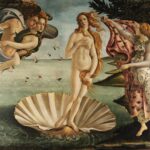
Detail from The Birth of Venus. Source: Print Collector / Print Collector/Getty Images

For researchers and art historians, tempera requires an entirely different technical methodology than oils. Because it cannot be applied in thick, juicy impasto strokes or blended smoothly on the canvas like oils, artists must build up forms through thousands of microscopic, translucent brushstrokes—a process known as hatching and cross-hatching. This gives true egg tempera a distinctive, luminous matte surface with a subtle, glowing internal depth, as light penetrates the thin layers of pigment before bouncing back off the white gesso ground. It does not yellow or darken significantly with age, which is why 14th-century altarpieces retain their jewel-like brilliance today. While largely superseded by the flexibility of oil painting during the Northern and Italian High Renaissance, tempera experienced major revivals during the Pre-Raphaelite movement, American Regionalism, and among modern precisionists who valued its sharp, graphic clarity.

Sculpting

Sculpting is the branch of the visual arts that operates in three dimensions. Unlike painting, which creates the illusion of depth, sculpture occupies physical space and is governed by the relationship between mass and void. Historically, it was divided into two primary processes: Subtractive (carving away material like stone or wood) and Additive (building up material like clay or wax).

For researchers and digital artists, sculpting is defined by its tactile nature and its interaction with real-world physics—specifically gravity and light. Modern “Digital Sculpting” mimics these traditional workflows using millions of polygons to simulate the “feel” of clay. Key concepts include:

  • Armature: The internal skeleton that supports the weight of the sculpture.

  • Contrapposto: The shifting of weight in the human figure to create a sense of life and potential movement.

  • Relief vs. Free-standing: Whether the work is attached to a background (like a coin) or can be viewed from all 360°.

Reset to Default
+ FAVORITES ✎
✕
⋮ ☆ Fresco
✕
HELP AGENT
PLEASE WAIT, LOADING...
×
MCA

--
Analyzing image & extracting data...

Link Copied!

General Inquiry

Have a question or feedback regarding portfolios? Drop us a line.

Strictly plain English text structure only.

Attachments Inventory

Max 500KB per file. Max 10 images.

Delivery Confirmed

Thank you. Your message and data structural packages have been safely transferred to our desk.

Artist Name Artwork Details
Search with Google Lens
Print...