Cgitems Logo
Entering
Tenebrism
Loading Encyclopedia...
Connecting to Cgitems Server...
Thanks for your patience
Tenebrism - CGItems
☆
  • UK - English UK - English
  • France - Français France - Français
  • Germany - Deutsch Germany - Deutsch
  • Netherlands - Nederlands Netherlands - Nederlands
  • Norway - Norsk Norway - Norsk
  • Denmark - Dansk Denmark - Dansk
  • Finland - Suomi Finland - Suomi
  • Vietnam - Tiếng Việt Vietnam - Tiếng Việt
  • Italy - Italiano Italy - Italiano
  • Sweden - Svenska Sweden - Svenska
  • Brazil - Português Brazil - Português
  • Greece - Ελληνικά Greece - Ελληνικά
  • Thailand - ไทย Thailand - ไทย
  • Iran - فارسی Iran - فارسی
  • Arab - العربية Arab - العربية
  • Spain - Español Spain - Español
  • China - 中文 China - 中文
  • Turkey - Türkçe Turkey - Türkçe
  • Russia - Русский Russia - Русский
  • South Korea - 한국어 South Korea - 한국어
  • Japan - 日本語 Japan - 日本語
  • India - हिन्दी India - हिन्दी

Art Movement , Style & Technique

Tenebrism

SUB CATEGORIES
×

Tenebrism

Tenebrism

A comprehensive guide to the visual principles, history, and pioneers of this movement. Curated for researchers and students seeking a structured analysis of artistic styles & Technique .

Available Art Style & Movement

Select Art Style...
  • Abstract
  • Abstract Expressionism
  • Academic Art
  • Aestheticism
  • Architectural Movements
  • Art Deco
  • Art Nouveau
  • Baroque
  • Bauhaus
  • Byzantine
  • Cartoon
  • CGI
  • Chiaroscuro
  • Chiaroscuro Noir
  • Classical Architecture
  • Classicism
  • Comic
  • Conceptual
  • Contemporary
  • Cubism
  • Dada
  • Early Renaissance
  • Expressionism
  • Fantasy Art
  • Fashion
  • Fashion Design
  • Fashion Illustration
  • Fashion Photography
  • Fauvism
  • Fresco
  • Gothic
  • Haute Couture
  • High Renaissance
  • Hybrid
  • Illustration
  • Impressionism
  • Landscape
  • Line art
  • Manga
  • Mannerism
  • Marvel
  • Matte Painting
  • Miniature
  • Minimalism
  • Modern Architecture
  • Modernism
  • Muralism
  • Neoclassicism
  • Orientalism
  • Photography
  • Pop Art
  • Pre-Raphaelite
  • Realism
  • Regionalism
  • Relief 
  • Renaissance
  • Rococo
  • Romanticism
  • SCI-FI
  • Sculpting
  • Street Art
  • Surrealism
  • Symbolism
  • Tempera
  • Tenebrism
  • Tonalism
  • VFX
  • Victorian

General Specifcations for Tenebrism

Tenebrism (from the Italian tenebroso, meaning dark, gloomy, or mysterious) is an extreme form of illumination in painting where profound darkness dominates the canvas, punctuated by intensely localized, harsh beams of light. While often confused with chiaroscuro , which is the use of light and shadow to create the illusion of three-dimensional volume, tenebrism is a broader compositional choice. In tenebrist works, the darkness acts as a suffocating void; there is no background, no atmospheric perspective, and no secondary bounce light. Subjects emerge dramatically from a pitch-black abyss, illuminated by a single, unseen, and highly directional light source, creating an immediate, visceral impact.

Related to Tenebrism

Note : The images below might not strictly correspond to the style and technique of Tenebrism, but rather represent an artist who also includes this approach in their portfolio.

Gerrit van Honthorst

Classification

  • Category: Painting, Cinematography, Photography.

  • Era/Period: Baroque (Early 17th Century).

  • Origin Location: Rome and Naples, Italy (subsequently spreading to Spain and the Dutch Republic).

Visual & Technical Specs

  • Key Visual Characteristics: Absolute black backgrounds, harsh geometric shadows, tight lighting falloff, and highly realistic, unidealized human figures caught in mid-action.

  • Color Palette: Dominated by pure, crushing blacks (Ivory or Bone Black), warm earthy mid-tones (Burnt Sienna, Raw Umber), and intense, stark highlights (Lead White) often tinted with warm yellows or crimsons.

  • Mediums & Tools: Oil on canvas, utilizing dark underpainting (imprimatura) where the artist pulls the light subjects out of a completely black or dark brown base.

Synthetic: High-contrast, single-source directional light; zero global illumination or ambient bounce; rapid light-to-shadow falloff.

Pioneers & Key Works

  1. Michelangelo Merisi da Caravaggio (The absolute founder)

  2. Artemisia Gentileschi

  3. Orazio Gentileschi

  4. Jusepe de Ribera

  5. Francisco de Zurbarán

  6. Georges de La Tour

  7. Gerrit van Honthorst

  8. Hendrick ter Brugghen

  9. Dirck van Baburen

  10. Matthias Stom

  11. Adam Elsheimer

  12. Trophime Bigot

  13. Valentin de Boulogne

  14. Nicolas Tournier

  15. Carlo Saraceni

  16. Giovanni Baglione

  17. Bartolomeo Manfredi

  18. Mattia Preti

  19. Luca Giordano

  20. Juan Bautista Maíno

20th & 21st-Century Revivalists:

  1. Odd Nerdrum (Painter)

  2. Gottfried Helnwein (Painter/Photographer)

  3. Nicola Samorì (Painter/Sculptor)

  4. Roberto Ferri (Painter)

  5. Ken Currie (Painter)

  6. Bill Viola (Video Artist)

  7. Gordon Willis (Cinematographer – known as the “Prince of Darkness”)

  8. Gregg Toland (Cinematographer)

  9. Floria Sigismondi (Director/Photographer)

  10. Alexander McQueen (Fashion Design/Runway Aesthetics)

Masterpieces:

  • The Calling of St Matthew (Caravaggio, 1599–1600)

  • Judith Slaying Holofernes (Artemisia Gentileschi, c. 1612–13)

  • The Matchmaker (Gerrit van Honthorst, 1625)

  • Saint Joseph Carpenter (Georges de La Tour, 1642)

  • The Martyrdom of Saint Philip (Jusepe de Ribera, 1639)

Philosophy & Context

Tenebrism was born out of the Counter-Reformation. The Catholic Church required art that was immediate, easily understandable, and emotionally overpowering to draw people back from Protestantism. By stripping away background environments and daylight, artists removed all distractions. The pure black void forces the viewer’s eye exactly where the artist dictates, isolating raw human psychology, suffering, or divine revelation in a gritty, hyper-realistic manner.

Modern Influence: Cinema, TV & CGI

2D, 3D, CGI, VFX: In modern 3D pipelines, the tenebrist approach is the equivalent of disabling all HDRI maps and ambient occlusion, relying exclusively on a single tightly focused Area Light or Spotlight with a volumetric cone. This “low-key lighting” is a staple in VFX for hiding unrefined background assets and focusing rendering power entirely on the protagonist or creature. It defines the visual language of modern noir, psychological thrillers, and deep-space sci-fi where the absence of light is just as important as the presence of it.

Modern Influence: AI & Hybrid Media

  • Modern Legacy: For AI generation, the Tenebrist style is highly effective for generating dramatic character portraits because it prevents the AI from hallucinating chaotic or crowded backgrounds, forcing it to concentrate on skin texture, cloth rendering, and facial expression.

  • AI Prompting Keywords: Tenebrism, Caravaggisti style, pure black background, stark contrast, harsh single-source directional lighting, deep shadows, underexposed environment, volumetric spotlight, chiaroscuro extreme.

Explore More

Early Renaissance 1

Some Other Art Styles

Art Styles by random seed

Fashion

Fashion is a dynamic, living art form that uses the human body as a three-dimensional canvas. It serves as a visual language reflecting sociological shifts, political climates, and technological advancements. As an academic and artistic category, Fashion encompasses four interconnected creative pillars:

  • Leda Fashion

    Garment Design (Haute Couture & Prêt-à-Porter): The structural manipulation of textiles through pattern-making, draping, and tailoring. It balances wearable architecture with human anatomy.

  • Fashion Illustration: The foundational translation of an idea from a two-dimensional sketch to a blueprint for production. Historically a fine-art discipline, it utilizes exaggerated proportions (the 9-head or 10-head figure rule) to emphasize line, movement, and textile drape.

  • Fashion Photography: The cinematic or editorial presentation of the garment. It shifted fashion from catalog documentation into a branch of surrealist, narrative-driven art, heavily utilizing studio lighting, staging, and creative direction.

Fashion History

Rococo-Fashion

Fashion history is essentially the story of the body being reshaped by the world around it.

    • Ancient & Medieval: Silhouettes were defined by fabric scarcity. Shapes were simple, geometric, and draped, as weaving was labor-intensive. Status was shown through rare dyes, not complex cuts.

    • Renaissance to Baroque: Silhouettes became architectures of leisure. Corsets, farthingales, and panniers were designed to make the wearer immobile, proving they were exempt from manual labor. The silhouette was a physical barrier between the elite and the productive class.

    • The Enlightenment & Victorian eras: Post-French Revolution, silhouettes briefly turned to Greek-inspired simplicity as a symbol of democracy. By the Victorian era, the Industrial Revolution triggered “conspicuous consumption,” leading to massive, rigid silhouettes like the crinoline to display newfound middle-class wealth.

    • The 20th Century: Wartime rationing forced fabric efficiency, leading to shorter, leaner, and more utilitarian forms. Women’s liberation then shattered these norms; hemlines rose and gender-neutral structures (like broad shoulders) replaced the obsession with the cinched waist.

Muralism

Muralism is a monumental, public-facing art movement defined by the creation of massive paintings directly executed on or permanently affixed to architectural surfaces (walls, ceilings, or structural facades). While mural-making dates back to prehistoric caves and Renaissance frescoes, “Modern Muralism”—sparked primarily by the Mexican Mural Movement in the 1920s—transformed the medium into a powerful vehicle for social, political, and historical narrative.

Unlike easel paintings, which are transportable and often treated as private commodities, modern muralism is intrinsically civic and democratic. It was designed to bypass the elite, exclusive spaces of museums and commercial galleries, taking art directly to the working-class public in municipal buildings, schools, and outdoor plazas.

For researchers, students, and CGI artists, Muralism must be understood as an architectural collaborator. A successful muralist does not merely use a wall as a flat canvas; they analyze the architectural volume, viewer sightlines, scale, and environmental lighting of the space.

Muralism Artwork By Diego Rivera,
“Dream of a Sunday Afternoon in Alameda Central Park” (Sueño de una tarde dominical en la Alameda Central) by Diego Rivera, created between 1946 and 1947.

Historically, the movement combined classical European fresco techniques with bold modernist styles like Cubism, Expressionism, and native indigenous folk art aesthetics to create highly legible, heroic, and dynamic visual spectacles.

Aestheticism

Aestheticism—often encapsulated by the famous French rallying cry “L’art pour l’art” (“Art for Art’s Sake”)—was a revolutionary late-19th-century avant-garde movement. It shook the foundation of Victorian culture by aggressively rejecting the idea that art must serve a moral, didactic, social, or political purpose. To the Aesthete, art didn’t need to tell a story, teach a lesson, or reform society; its sole justification was the pursuit of pure, sensual beauty and visual pleasure.

William Blake Richmond Artwork

For researchers and art students, the movement is defined by its deep intellectualism and intense focus on formal qualities over narrative content. It treated composition as a purely musical arrangement where lines, colors, and textures interact to evoke a mood. The movement heavily rebelled against industrial mass production and the “gaudy” or “stuffy” interior designs of the high Victorian era, seeking instead to cultivate an entirely beautiful lifestyle. Rather than treating nature as the ultimate ideal, Aesthetes often viewed nature as crude, unfinished, and lacking design until refined by human artistic intelligence.


A major catalyst for this style was Japonisme (the late-19th-century craze for Japanese art). The sudden influx of Japanese woodblock prints and decorative screens provided artists with alternative design principles: flat planes of color, radical asymmetry, stylized natural motifs, and a refined sense of decorative spacing that bypassed traditional Western perspective.

Baroque

The Baroque art movement represents a period of extreme visual exuberance, dramatic intensity, and monumental grandeur that swept across Europe following the Renaissance and Mannerist periods. Rooted initially in the Catholic Church’s Counter-Reformation efforts to inspire awe and devotion, Baroque art breaks the fourth wall, pulling the viewer directly into the emotional climax of the scene.

Narcissus by Caravaggio
arcissus by Caravaggio (Tenebrism)

Unlike the calm, balanced, and idealized compositions of the High Renaissance, Baroque art is characterized by tension, instability, and explosive movement. In painting, this is achieved through aggressive diagonals and deep, enveloping shadows piercing through brilliant, theatrical spotlights. In sculpture and architecture, it manifests through twisting forms, undulating facades, and the blurring of boundaries between different mediums—often combining painting, stucco, and sculpture into a single, overwhelming spatial experience (bel composto).

Miniature

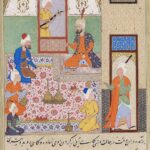
Miniature painting is a highly disciplined, small-scale art form characterized by extreme precision, vibrant mineral pigments, and a rejection of Western three-dimensional perspective. While each region has its own identity, they share a “flat” or isometric perspective, where the importance of a subject is dictated by its placement or color rather than its distance from the viewer.

  • Persian (Iranian) Miniature: Known for the “Herat” and “Safavid” schools. It features lyrical compositions, intricate “Tazhib” (illumination), and a focus on epic poetry (Shahnameh) and mysticism.

  • Indian (Mughal/Rajput) Miniature: A fusion of Persian technique and Indian flora/fauna. It introduced more naturalism, portraiture, and the “Ragmala” (musical modes) paintings.

  • East Asian (China/Japan) Influence: While often appearing as scrolls, the “miniature” element exists in Album Leaves and Fan Paintings. They emphasize calligraphic line work, the “spirit resonance” of brushstrokes, and the philosophical use of “negative space” (Ma).

Fauvism

Fauvism was the first of the major avant-garde movements of the 20th century. Its name originated from the French word les Fauves (“the wild beasts”), a term coined by critic Louis Vauxcelles after he saw the shocking, non-naturalistic colors at the 1905 Salon d’Automne.

For researchers and students, the defining technical achievement of Fauvism was the liberation of color. Before this movement, color was used to describe an object (a tree is green); Fauvist artists used color to describe an emotion or a formal sensation (a tree can be bright red if it feels right to the artist). While the movement was short-lived (lasting barely a decade), it laid the groundwork for Expressionism and all subsequent abstract art by proving that art did not need to mimic the physical world to be “true.”

Reset to Default
+ FAVORITES ✎
✕
⋮ ☆ Tenebrism
✕
HELP AGENT
PLEASE WAIT, LOADING...
×
MCA

--
Analyzing image & extracting data...

Link Copied!

General Inquiry

Have a question or feedback regarding portfolios? Drop us a line.

Strictly plain English text structure only.

Attachments Inventory

Max 500KB per file. Max 10 images.

Delivery Confirmed

Thank you. Your message and data structural packages have been safely transferred to our desk.

Artist Name Artwork Details
Search with Google Lens
Print...