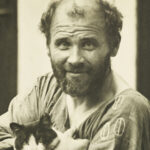

Egon Leo Adolf Ludwig Schiele was a highly influential Austrian painter and a leading figure of early 20th-century Expressionism. Known for his intense, raw, and often sexually explicit depictions of the human form, his work challenged the conservative societal norms of his time. Born in the railway station of Tulln where his father was a stationmaster, Schiele showed an early obsession with drawing. Following his father’s death from syphilis, he was sent to Vienna, eventually enrolling in the Academy of Fine Arts in 1906 at the age of sixteen. Frustrated by the academy’s rigid conservatism, he left after three years to form the Neukunstgruppe (New Art Group).
In 1907, Schiele sought out Gustav Klimt, who became his mentor, patron, and lifelong friend. Klimt introduced Schiele to the Vienna Secession and the Wiener Werkstätte, buying his drawings and arranging models for him. While Schiele’s early work showed Klimt’s decorative, Art Nouveau influence, he rapidly developed a highly distinct, aggressive style. His mature works feature contorted bodies, skeletal figures, and a profound psychological intensity, often exploring themes of death, sexuality, and existential anxiety.
Schiele’s provocative lifestyle and art led to scandal. In 1912, he was arrested in the town of Neulengbach on charges of seducing a minor and exhibiting pornography. Though the most severe charges were dropped, he spent 24 days in prison, an experience that deeply traumatized him but also resulted in a series of poignant prison drawings. Upon returning to Vienna, he achieved growing critical and commercial success, eventually marrying Edith Harms in 1915, which brought a slightly more grounded and less tormented quality to his final works.
His career was cut tragically short just as he was achieving peak international recognition. In the autumn of 1918, the Spanish flu pandemic struck Vienna. Edith, who was six months pregnant, died on October 28. Egon Schiele succumbed to the same disease three days later on October 31, 1918, at the age of just 28.
Active in others filds :
Poetry (Schiele wrote several Expressionist poems, often melancholic and introspective, which were published in avant-garde journals alongside his illustrations).
Notable Collaborations :
Gustav Klimt (mentor and key promoter who invited him to exhibit at the 1909 Kunstschau), Arthur Roessler (influential art critic and early patron who documented his career), Heinrich Benesch (art collector and dedicated patron), and the Wiener Werkstätte (contributed graphic designs and illustrations).
Egon Schiele Legacy :
Died at 28, but left an immense legacy as a foundational master of Expressionism. Despite his brief career, Schiele produced over 300 oil paintings and several thousand drawings and watercolors. His unapologetic, visceral approach to the human body and psychological portraiture profoundly influenced late 20th-century figurative artists, including Francis Bacon and Lucian Freud. His works are now considered Austrian national treasures and represent a critical pivot from decorative Art Nouveau to raw psychological modernism.
Selected Notable Works :
Portrait of Wally Neuzil (1912), Self-Portrait with Physalis (1912), The Hermits (1912), Cardinal and Nun (Caress) (1912), Death and the Maiden (1915), Edith Schiele in a Striped Dress (1915), The Embrace (1917), Four Trees (1917), Sitting Woman with Legs Drawn Up (1917), The Family (1918)
Awards and Honors :
Received no official institutional awards or honors during his lifetime due to his controversial reputation and early death, recognized posthumously as a primary pillar of Austrian Modernism, works designated as cultural heritage by the Austrian state.
Exhibitions & Art Venues :
Leopold Museum (Vienna), Belvedere Palace (Vienna), Albertina Museum (Vienna), Neue Galerie (New York), The Metropolitan Museum of Art (New York), Kunsthaus Zürich, Tate Modern (London), Museum of Modern Art (New York), Egon Schiele Museum (Tulln)