

Magdalena Carmen Frida Kahlo y Calderón Real name and family : Magdalena Carmen Frida Kahlo y Calderón (Father: Guillermo Kahlo, a German-born photographer; Mother: Matilde Calderón y González; Spouse: Diego Rivera, the famous Mexican muralist) was a Mexican painter best known for her uncompromising, brilliantly colored self-portraits that deal with themes of identity, the human body, death, and physical pain. While frequently classified by European critics as a Surrealist, Kahlo rejected the label, famously stating, “They thought I was a Surrealist, but I wasn’t. I never painted dreams. I painted my own reality.”
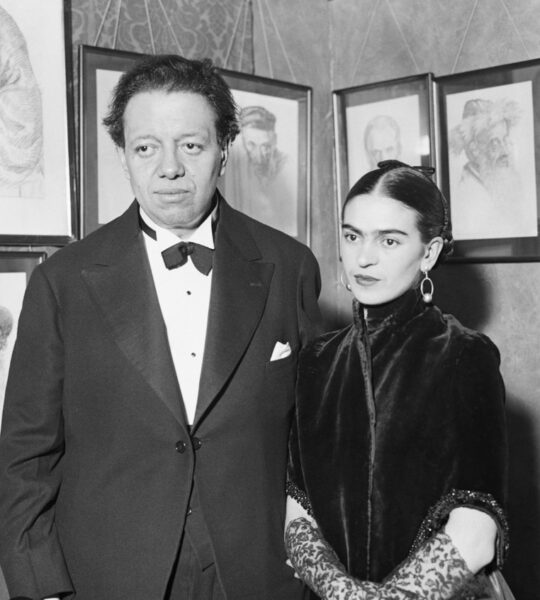 Diego Rivera & Frida Kahlo
Her life was defined by severe physical hardship. At age six, she contracted polio, which left her right leg thinner and shorter than her left. In 1925, at the age of eighteen, she survived a catastrophic bus accident where an iron handrail pierced her pelvis. The accident caused near-fatal injuries, requiring over thirty surgeries throughout her life and forcing her to endure long periods of isolation in full-body plaster casts. It was during her lengthy recovery that she abandoned her medical studies and took up painting, utilizing a custom lap easel and a mirror installed on the canopy of her bed to capture her own image.
In 1929, Kahlo married the celebrated Mexican muralist Diego Rivera. Their relationship was highly volatile, marked by immense artistic mutual respect, numerous extramarital affairs on both sides, a divorce in 1939, and a remarriage in 1940. This emotional turmoil heavily fed her artwork. Her compositions frequently integrated traditional Mexican folk art, pre-Columbian mythology, Catholic votive imagery, and bloody anatomical motifs.
Her masterpieces include The Two Fridas (1939), painted shortly after her divorce, which illustrates her fractured identity between her European and indigenous Mexican heritages. Another iconic work, The Broken Column (1944), lays bare her chronic physical suffering, depicting her torso split open to reveal an ionic stone column crumbling in place of her spine, her flesh pierced by nails.
Kahlo spent the majority of her life living and working in La Casa Azul (The Blue House) in Coyoacán. Despite her failing health, she remained politically active as a staunch communist and attended her first solo exhibition in Mexico in 1953 arriving in an ambulance. She passed away in her beloved home in 1954 at the age of forty-seven.
Active in others filds : Political Activism (Mexican Communist Party), Writing (Extensive personal diaries and illustrated letters).
Frida Kahlo Legacy : During her lifetime, Frida Kahlo was primarily known in the art world as “Diego Rivera’s eccentric wife.” However, the late 1970s marked the beginning of a massive cultural phenomenon known as “Fridamania,” which transformed her into a global icon. Today, her legacy is celebrated as a foundational pillar of feminist art, LGBTQ+ representation, and Chicano identity. By centering her art entirely around the female experience, chronic illness, and psychological trauma, she broke historical taboos and expanded what was considered acceptable subject matter in fine art. Her highly stylized personal aesthetic—including her traditional Tehuana dresses, floral headdresses, and proud unibrow—has become universally recognized, influencing modern fashion, pop culture, and visual storytelling worldwide.