

What Is Perspective? A Complete Guide for Artists, Photographers, Filmmakers and Engineers
CGItems.co.uk | Visual Arts Encyclopedia
Perspective is the system that lets a flat surface describe a three-dimensional world. Every time a road narrows toward the horizon in a painting, a corridor recedes in a film frame, or a building is drawn in a technical plan, a set of geometric rules is at work. This article explains what perspective is, how it works across painting, photography, cinema and engineering, why the horizon line matters, how the different types of perspective differ, how lens choice relates to it, and which artists shaped the way we use it today.
1. What Is Perspective?
In its simplest definition, perspective is a method of representing three-dimensional space on a two-dimensional surface so that the result resembles what the eye sees. The word comes from the Latin perspicere, “to see through”. Its core idea is projection: imagine a transparent window between the viewer and the scene, trace every point of the scene onto that window along the line of sight, and the traced image is a perspective drawing.
Three visual effects follow from this projection:
- Size diminution: objects of equal size appear smaller as they get farther from the viewer.
- Convergence: parallel lines that recede from the viewer appear to meet at a point in the distance, called a vanishing point.
- Foreshortening: surfaces and forms that angle away from the viewer appear compressed along the direction of depth.
Perspective is not one single technique. It is a family of projection systems, each with its own rules and purposes.
2. The Basic Principles of Perspective
Almost every perspective system rests on a small vocabulary:
- Station point: the position of the viewer’s eye (or the camera).
- Picture plane: the imaginary transparent surface on which the scene is projected. In a painting it is the canvas; in photography it is the sensor.
- Line of sight / central axis: the line from the eye perpendicular to the picture plane.
- Horizon line: the horizontal line at the viewer’s eye level (see section 3).
- Vanishing point (VP): the point on the horizon where a set of parallel lines, parallel to each other in reality, appear to converge.
- Orthogonals: the receding lines that run toward a vanishing point.
- Transversals: lines parallel to the picture plane, which stay parallel and do not converge.
- Cone of vision: the field the eye takes in comfortably, usually treated as roughly 40 to 60 degrees. Content far outside this cone becomes visibly stretched in strict linear perspective.
The central rule: all parallel lines that are not parallel to the picture plane converge at a vanishing point, and all vanishing points for horizontal lines lie on the horizon.
3. The Horizon Line
The horizon line is the most important single decision in a perspective construction.
What it is. The horizon line represents the viewer’s eye level. In the real world it is where sky meets land or sea, but in perspective theory it exists even when the true horizon is hidden by hills, buildings or trees. A key practical consequence: the horizon line always sits at the height of your eyes (or lens).
What it controls.
- Everything above the horizon line is seen from below; everything below it is seen from above.
- Any object whose top is exactly on the horizon line is exactly as tall as the eye level. In a crowd drawn on level ground, all heads at the same height as the viewer fall on the horizon line, which is an effective way to keep figures consistent in scale.
- Vanishing points for horizontal parallels (roads, rails, floors, ceilings, building edges) are all located on the horizon line.
Compositional effects.
- Low horizon: emphasizes sky and verticality; subjects appear monumental, powerful or heroic.
- High horizon: emphasizes the ground plane and spatial layout; subjects appear smaller, with a map-like or observational feeling.
- Centered horizon: gives a stable, symmetrical, sometimes static composition.
- Horizon outside the frame: common in photography and cinema. If the camera is tilted up, the horizon falls below the frame; if tilted down, above it. The horizon still exists geometrically.
When the camera or picture plane is tilted, vertical lines also begin to converge, which leads to three-point perspective (section 5).
4. Perspective in Different Disciplines
Perspective in Painting and Drawing
For painters, perspective is a tool for constructing believable space. Renaissance artists made it a rigorous mathematical system, but painters also use softer, observational techniques: overlapping forms, scale changes, and atmospheric effects (see section 5). In practice, many painters combine a constructed perspective skeleton with intuitive adjustment, and some deliberately break the rules for expressive reasons.
Perspective in Photography
In photography, perspective is produced automatically by optics. The camera creates a perspective image of the scene, and the photographer controls it through three choices: camera position, camera angle, and focal length (framing). Camera position is the one that truly changes the geometry (see section 6). Tilt and shift movements, whether physical (tilt-shift lenses and view cameras) or digital, can correct converging verticals in architectural photography.
Perspective in Cinema
Cinema uses perspective both as geometry and as storytelling. One-point perspective, with the camera centered on a corridor or road, produces symmetry, tension and control; it is strongly associated with the work of Stanley Kubrick. Wide-angle lenses placed close to actors exaggerate depth and distort proportions, while long lenses compress distance and flatten space. Filmmakers also manipulate perspective with practical illusions: forced perspective (placing small objects near the camera and large ones far away so they appear to share the same space, famously used to make actors look like hobbits in The Lord of the Rings), the Ames room, and the dolly zoom (a simultaneous camera move and zoom in opposite directions that changes perspective relationships while keeping the subject the same size in frame, popularized by Hitchcock in Vertigo and by Spielberg in Jaws). In visual effects and CGI, the virtual camera must match the real camera’s position, lens and horizon exactly, otherwise composited elements will not sit in the plate.
Perspective in Engineering, Architecture and Technical Drawing
In engineering, the priority is often measurement rather than realism. For that reason, technical drawing mostly uses parallel projections, in which the lines of projection are parallel and therefore do not converge:
- Orthographic projection: plan, elevation and section views, showing true dimensions.
- Axonometric projection: isometric, dimetric and trimetric drawings, showing three faces of an object at once with consistent scale along the axes.
- Oblique projection: cavalier and cabinet projections, where one face is drawn true to shape and depth lines are drawn at an angle.
True linear perspective is used in architectural visualization, product design and presentation drawings, where the goal is to show how a building or object will actually be seen. The mathematical foundation of all these systems is descriptive geometry, systematized by Gaspard Monge at the end of the 18th century. Today, 3D software generates perspective automatically through a virtual camera and projection matrix, and offers orthographic cameras as the parallel-projection alternative.
5. Types of Perspective
Linear Perspective
Linear perspective uses lines and vanishing points. It is classified by the number of vanishing points.
One-point perspective. One face of the subject is parallel to the picture plane. Lines parallel to the picture plane remain horizontal and vertical; only the depth lines converge, to a single vanishing point on the horizon. It is ideal for roads, corridors, railways, interiors and frontal views, and gives strong symmetry and focus.
Two-point perspective. The subject is turned at an angle, so no face is parallel to the picture plane. Two sets of horizontal lines converge at two vanishing points on the horizon, while vertical lines stay vertical. It is the standard system for exteriors, architecture and product drawing, and feels dynamic and natural.
Three-point perspective. A third vanishing point is added above or below, so vertical lines also converge. It occurs when you look sharply up at a tall building (the verticals converge upward) or sharply down from a height (they converge downward). It produces drama, scale and vertigo.
Four-point, five-point and curvilinear perspective. For very wide fields of view, straight lines are drawn as curves. Four-point perspective is used for views of about 180 degrees, five-point (and its relatives, developed by Albert Flocon and André Barre) for full panoramic or fisheye-like views. This is the geometry of fisheye lenses and 360-degree panoramas.
Atmospheric (Aerial) Perspective
Atmospheric perspective uses the effect of air and distance on color and contrast. Distant objects become lighter, bluer, less saturated, and lower in contrast and detail. It does not rely on lines at all and works together with linear perspective. Leonardo da Vinci described it in detail, and it is the technique behind the blue distance in countless landscapes.
Overlapping, Scale and Position
The simplest depth cues are overlap (near objects cover far ones), relative size, and vertical placement in the picture (objects farther away on a ground plane sit higher in the picture). Medieval and non-Western traditions used these cues effectively long before linear perspective.
Foreshortening
Foreshortening is perspective applied to a single form: an arm pointing toward the viewer, or a reclining figure. Andrea Mantegna’s Lamentation over the Dead Christ (c. 1480) is a famous example.
Inverse (Reverse) Perspective
In Byzantine and Russian icon painting, lines often diverge toward the viewer instead of converging into the distance, so the vanishing point is effectively in the viewer’s space. This is a deliberate symbolic system, not a mistake, and it was studied by the Russian philosopher Pavel Florensky.
Isometric and Axonometric Projection
These are parallel projections (section 4) and have no vanishing points. They are widely used in engineering, games, and interface design because measurements remain consistent.
Anamorphic Perspective
Anamorphosis distorts an image so that it looks correct only from one special viewpoint or with a special device. Hans Holbein’s The Ambassadors (1533) contains the best-known example, a stretched skull that resolves when viewed from the side. Modern 3D pavement art uses the same principle.
6. Perspective and Lens Choice
This is an area full of popular half-truths, so precision matters.
The geometry of perspective is determined by the position of the viewpoint, not by the lens. Perspective is the relationship between near and far objects, and that depends on where the camera is. If you stay in exactly the same spot and change focal length, the perspective relationships do not change; you only change how much of the scene is included. A telephoto shot is mathematically the same as a crop of a wide-angle shot taken from the same position (apart from resolution and lens aberrations).
So why do lenses seem to change perspective? Because photographers move to keep the subject the same size:
- With a wide-angle lens you move close to the subject to fill the frame. The close position creates strong size differences between near and far objects, so depth looks exaggerated, features near the camera look enlarged, and lines converge sharply.
- With a telephoto lens you step back to keep the subject the same size. The far position means near and far objects are closer in relative scale, so depth looks compressed and the background appears enlarged and closer behind the subject.
- A normal lens (about 50 mm on full frame) gives a field of view close to the comfortable cone of vision.
Approximate horizontal field of view on a full-frame (36 mm wide) sensor
| Focal length | Horizontal angle of view | Typical character |
|---|---|---|
| 14 mm | ~104° | Extreme wide, strong stretching at edges |
| 24 mm | ~74° | Wide, architectural and environmental |
| 50 mm | ~40° | Normal, natural look |
| 85 mm | ~24° | Short telephoto, classic portrait |
| 200 mm | ~10° | Telephoto, strong compression |
The formula is: angle of view = 2 × arctan(sensor width ÷ (2 × focal length)).
Wide-angle edge distortion. At very wide angles, objects near the edges of the frame (especially spheres and faces) are stretched. This is a consequence of projecting a wide cone of view onto a flat plane (rectilinear projection), not a lens flaw, and it is the same reason strict linear perspective is limited to a cone of roughly 40 to 60 degrees in painting.
Lens distortion is a separate issue. Barrel and pincushion distortion are optical imperfections that bend straight lines, and they are different from perspective.
The Painter’s Equivalent
Painters have no lens, but they choose the same two parameters: viewing distance and field of view. A painter who stands close to a scene and paints a wide view is behaving like a wide-angle photographer; a painter who works from far away and paints a narrow slice is behaving like a telephoto photographer. Renaissance theorists described this as the “distance point”: the farther the station point, the less the convergence and the flatter the space. Some art historians also argue that painters like Vermeer used the camera obscura, an optical device that projects a perspective image, though how much is still debated. David Hockney’s book Secret Knowledge made that argument famously, and critics have challenged it.
7. Perspective in the Work of Leonardo da Vinci

Leonardo (1452-1519) treated perspective as both a science and an artistic tool. He divided it into three kinds in his writings on painting: linear perspective (the shrinking of size with distance), perspective of color (the change of color with distance), and perspective of disappearance (the loss of sharpness and detail with distance). The last two together are what we now call atmospheric perspective.
Key examples:
- The Last Supper (c. 1495-1498, Santa Maria delle Grazie, Milan). A textbook one-point perspective. The vanishing point is located behind the head of Christ, at the center of the composition, so that all the orthogonals of the ceiling beams, wall tapestries and room architecture lead the eye to him. Technical studies have found a small hole at the vanishing point where Leonardo is thought to have fixed a string to snap guide lines across the wall.
- The Adoration of the Magi (1481, unfinished, Uffizi, Florence). Leonardo’s detailed underdrawing includes a complex perspective construction with ruined architecture and a staircase in the background, showing how he built space with a mathematical framework before adding figures.
- The Annunciation (c. 1472-1476, Uffizi). An early work with carefully constructed architecture and an atmospheric garden landscape.
- The Mona Lisa and The Virgin of the Rocks. Both show atmospheric perspective: the distant landscapes dissolve into blue-green haze. In the Mona Lisa, the horizon level also differs slightly between the left and right sides of the background, a subtle feature that has fascinated viewers for centuries.
Leonardo also studied the optics of the eye and the geometry of light and shadow, and his notebooks contain many perspective diagrams. His collaboration with the mathematician Luca Pacioli, who wrote De divina proportione (1509), which Leonardo illustrated, shows how closely art and mathematics were linked in his work.
8. The Pioneers: How Perspective Developed
Antiquity. Greek and Roman painters used partial perspective techniques, including foreshortening and convergence of some lines, as shown in Pompeian wall paintings, but never developed a single unified system. Euclid’s Optics provided the geometry of vision.
Middle Ages. Byzantine, Islamic and medieval European art emphasized symbolic space, often using inverse perspective or stacked, flat compositions. In the Islamic world, Ibn al-Haytham (Alhazen, c. 965-1040) wrote the Book of Optics, a foundation for later European optical theory.
- Filippo Brunelleschi (1377-1446) is credited with the first demonstration of true linear perspective around 1415-1420, in a famous experiment in Florence in which a painted view of the Baptistery could be compared with the real building through a peephole and a mirror.
- Masaccio (1401-1428) applied the new system in The Holy Trinity (c. 1427, Santa Maria Novella, Florence), widely considered the first painting with a fully consistent linear perspective.
- Leon Battista Alberti (1404-1472) wrote De pictura (1435), the first written treatise on the subject. He defined the picture as a “window” onto the world and described the construction of a perspective grid.
- Paolo Uccello (1397-1475) was famously obsessed with perspective, as in The Battle of San Romano, where broken lances and fallen bodies are arranged to lead the eye into depth.
- Piero della Francesca (c. 1415-1492) wrote De prospectiva pingendi and painted works such as The Flagellation of Christ with rigorous mathematical precision.
- Andrea Mantegna (c. 1431-1506) used dramatic foreshortening and illusionistic ceiling perspective.
High Renaissance. Leonardo da Vinci, Raphael (The School of Athens, 1509-1511, an iconic one-point perspective with a grand architectural vault), and Michelangelo brought perspective into an integrated artistic language.
Northern Europe. Albrecht Dürer (1471-1528) traveled to Italy, studied perspective, and published Underweysung der Messung (1525), which included illustrations of perspective drawing machines. Jan van Eyck and the Flemish painters developed a more empirical, observation-based perspective, along with outstanding atmospheric effects.
Baroque and later. Andrea Pozzo mastered quadratura, ceiling frescoes that appear to open into the sky (Sant’Ignazio, Rome). Canaletto and Bernardo Bellotto produced precise city views, often using the camera obscura. Brook Taylor (1715) published a mathematical theory of linear perspective, formalizing vanishing points. William Hogarth’s Satire on False Perspective (1754) is a playful catalog of perspective errors.
Perspective in Asian art. Chinese and Japanese traditions used different spatial systems, such as the “floating” or shifting viewpoint of Chinese scroll painting, and isometric-like projections. In the 18th and 19th centuries, Japanese printmakers adopted Western linear perspective in uki-e (“floating pictures”), and later masters such as Hokusai and Hiroshige combined it with their own compositional language, in turn influencing Impressionists and Post-Impressionists in Europe.
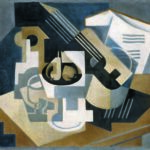
Modern challenges to perspective. Paul Cézanne showed the same scene from several viewpoints at once, and Picasso and Braque carried this further into Cubism. Surrealists such as Giorgio de Chirico, Salvador Dalí and René Magritte used perspective to create dreamlike, disquieting space. M. C. Escher exploited and subverted its rules in impossible constructions such as Relativity and Ascending and Descending.
9. Great Artists of Perspective Through History
| Artist | Period | Contribution |
|---|---|---|
| Giotto di Bondone | c. 1267-1337 | Early experiments with spatial depth and convergence |
| Filippo Brunelleschi | 1377-1446 | Demonstrated linear perspective |
| Masaccio | 1401-1428 | First fully consistent perspective in painting |
| Leon Battista Alberti | 1404-1472 | First perspective treatise, De pictura |
| Paolo Uccello | 1397-1475 | Perspective as an obsession and subject |
| Piero della Francesca | c. 1415-1492 | Mathematical rigor, De prospectiva pingendi |
| Andrea Mantegna | c. 1431-1506 | Dramatic foreshortening |
| Leonardo da Vinci | 1452-1519 | Linear, color and atmospheric perspective; The Last Supper |
| Albrecht Dürer | 1471-1528 | Perspective machines, northern treatise |
| Raphael | 1483-1520 | The School of Athens |
| Hans Holbein the Younger | c. 1497-1543 | Anamorphosis in The Ambassadors |
| Andrea Pozzo | 1642-1709 | Illusionistic ceiling frescoes (quadratura) |
| Canaletto | 1697-1768 | Precise architectural vedute |
| Brook Taylor | 1685-1731 | Mathematical theory of vanishing points |
| Hokusai / Hiroshige | 1760-1849 / 1797-1858 | East-West synthesis of perspective in prints |
| Paul Cézanne | 1839-1906 | Multiple viewpoints |
| Pablo Picasso / Georges Braque | 1881-1973 / 1882-1963 | Cubism, breaking single-point perspective |
| Giorgio de Chirico | 1888-1978 | Metaphysical, disquieting perspective |
| M. C. Escher | 1898-1972 | Impossible and paradoxical perspective |
| Salvador Dalí | 1904-1989 | Surrealist space and anamorphic play |
10. Contemporary Artists Working with Perspective
Perspective remains a living subject. A selection of artists whose work engages with it today:
- David Hockney (b. 1937): his photographic “joiners” and later paintings, together with his writing, challenge single-point perspective and propose a multi-viewpoint, time-based way of seeing.
- Patrick Hughes (b. 1939): inventor of “reverspective”, three-dimensional painted constructions in which the receding perspective appears to move as the viewer walks past.
- Julian Beever (b. 1959): famous for 3D pavement drawings that use anamorphic perspective, so they appear to rise from the ground when seen from the right spot.
- Kurt Wenner (b. 1958): the originator of modern 3D street painting, trained in classical perspective techniques.
- Edgar Mueller (b. 1968): large-scale 3D street paintings, including illusions of ice crevasses and sinkholes.
- Felice Varini (b. 1952): paints shapes across architectural spaces that resolve into a perfect geometric figure only from one viewpoint.
- Georges Rousse (b. 1947): photographs anamorphic paintings made inside abandoned buildings.
- Roger Hiorns, Olafur Eliasson and James Turrell work with perception and spatial experience in installation form, often relating to how viewers read space.
- Gregory Crewdson and Andreas Gursky: photographers whose carefully constructed images use perspective and viewpoint (high horizons, deep space, frontal symmetry) as central compositional tools.
- Wes Anderson and Roger Deakins: in cinema, Anderson’s centered one-point compositions and Deakins’ precise wide-lens depth staging show perspective as a directorial signature.
- Digital and CGI artists: concept artists, matte painters and VFX supervisors working in 3D software and with AI tools use virtual cameras, matched lenses and horizon matching every day; correct perspective is what makes a composite or a generated image believable.
(Editor’s note: please verify and adjust this list to match the artists you want to feature on CGItems.)
11. Conclusion
Perspective is both a science and an art. Geometry provides its rules: a viewpoint, a picture plane, a horizon line and vanishing points. Art provides its meaning: the choice of where to stand, how high to place the horizon, which lens or field of view to use, and when to follow or break the rules.
The key points to remember are these. The horizon line is the eye level of the viewer, and every horizontal vanishing point lies on it. One-, two- and three-point perspective differ in how the subject is oriented to the picture plane. Engineering relies on parallel projections when measurement matters more than appearance. In photography and film, the viewpoint, not the focal length, determines perspective, while the lens determines framing and how far the photographer must move. And from Brunelleschi and Leonardo to Hockney, Escher and today’s digital artists, each generation has either mastered the rules of perspective or deliberately broken them to say something new.
Whether you paint, photograph, direct, design or build in 3D, a solid understanding of perspective is one of the most valuable foundations a visual artist can have.
Further reading: Alberti, On Painting; Piero della Francesca, De prospectiva pingendi; Dürer, Underweysung der Messung; Martin Kemp, The Science of Art; Samuel Y. Edgerton, The Renaissance Rediscovery of Linear Perspective; Erwin Panofsky, Perspective as Symbolic Form.