


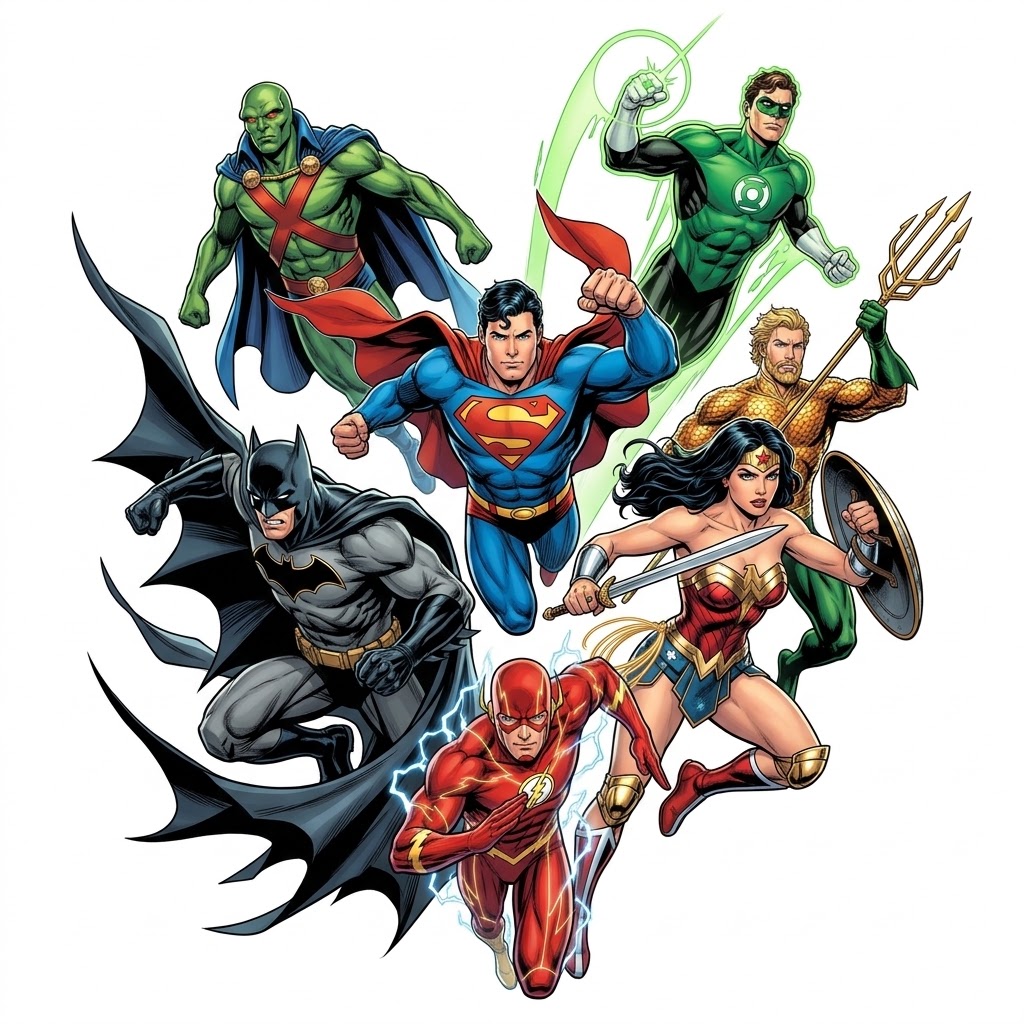
The Visual Pantheon of the Justice League: Designing a Modern Mythology
Bringing the Justice League of America to the canvas, page, or screen is one of the most monumental challenges in collaborative character design and environmental layout. For the visual artist, assembling the DC Universe’s greatest heroes is not merely a matter of drawing multiple characters; it is a complex exercise in compositional balance, color theory, and spatial dynamics. Documenting this team’s evolution for cgitems requires analyzing how generations of illustrators, animators, and VFX directors have managed to harmonize wildly contrasting visual identities—from the shadowy grit of Batman to the luminescent, cosmic power of Superman and Green Lantern—into a cohesive, awe-inspiring ensemble.
The Genesis: Fox, Sekowsky, and the Silver Age Assembly The Justice League of America debuted in 1960 in The Brave and the Bold number 28, conceived by writer Gardner Fox and artist Mike Sekowsky. Replacing the Golden Age Justice Society, this new roster was designed for the Atomic Age. Sekowsky faced the unprecedented challenge of staging multiple primary-colored icons within a single frame without creating visual clutter. His solution heavily relied on dynamic blocking and the architectural grounding of the Secret Sanctuary in Happy Harbor. By designing wide, cavernous interiors and staging the heroes around a central meeting table, Sekowsky established a visual language of equality and scale, ensuring that even when standing still, these modern gods felt monumental.
The Satellite Era: George Pérez and the Art of the Crowd As the 1970s and 80s expanded the roster to include dozens of heroes, the visual demands of the comic page skyrocketed. This era introduced the Justice League Satellite, a massive orbital headquarters that presented environment artists with the opportunity to design intricate, futuristic sci-fi interiors suspended against the endless black of space. The defining artist of this era was George Pérez, a master of hyper-detailed anatomical rendering and profound compositional depth. Pérez possessed an unparalleled ability to draw twenty distinct characters in a single splash page while maintaining perfect perspective, readable action, and distinct body language. His intricate cross-hatching and flawless spatial arrangements set the gold standard for massive superhero crossover events.
Animated Geometry: The Timmverse and Widescreen Choreography Translating the Justice League to television in 2001 required a radical streamlining of visual assets. Spearheaded by Bruce Timm and James Tucker, the Justice League animated series unified the sprawling DC universe under a single, cohesive aesthetic. The animation teams utilized bold, geometric silhouettes, pushing the “Dark Deco” style of earlier Batman cartoons into a brighter, more expansive arena. The true triumph of the series was its storyboard choreography. Directors utilized widescreen framing to capture massive, team-based combo attacks, forcing animators to master the intersecting physics of flight, super-speed, and martial arts. The show also introduced the Watchtower, a sprawling, brutalist space station that served as a masterpiece of 3D layout and atmospheric background painting.
Cinematic Scale: Rendering the Gods in Live-Action Bringing the Justice League into the modern live-action era demanded cutting-edge visual effects pipelines and masterful cinematography. The challenge for VFX supervisors and lighting directors is the extreme contrast in material shaders and particle effects required in a single shot. A frame might contain the matte, light-absorbing textures of Batman’s tactical armor, the highly reflective specular highlights of Wonder Woman’s metallic plating, and the volumetric, emissive light sources generated by Cyborg’s technology or the Flash’s Speed Force lightning. Zack Snyder’s interpretation of the team leaned heavily into high-contrast chiaroscuro lighting and desaturated color grading, utilizing massive, fully digital 3D environments to simulate apocalyptic alien terraforming and god-like kinetic impacts that would be impossible to capture practically.
Modern Epics and the Ultimate Compositional Challenge In contemporary illustration, the Justice League remains the ultimate test of a master artist’s capabilities. Legendary painters like Alex Ross have redefined the team’s visual legacy in works like Justice and Kingdom Come. By utilizing traditional gouache and watercolors alongside live-action reference models, Ross grounds the fantastic powers of the League in photorealistic, classical portraiture, treating them less like comic characters and more like Greco-Roman deities. For today’s 3D environment layout designers, character sculptors, and digital painters, crafting a Justice League scene is a relentless test of balancing varied light sources, deeply textured materials, and extreme scales, ensuring that each hero shines without eclipsing the majesty of the pantheon itself.

