


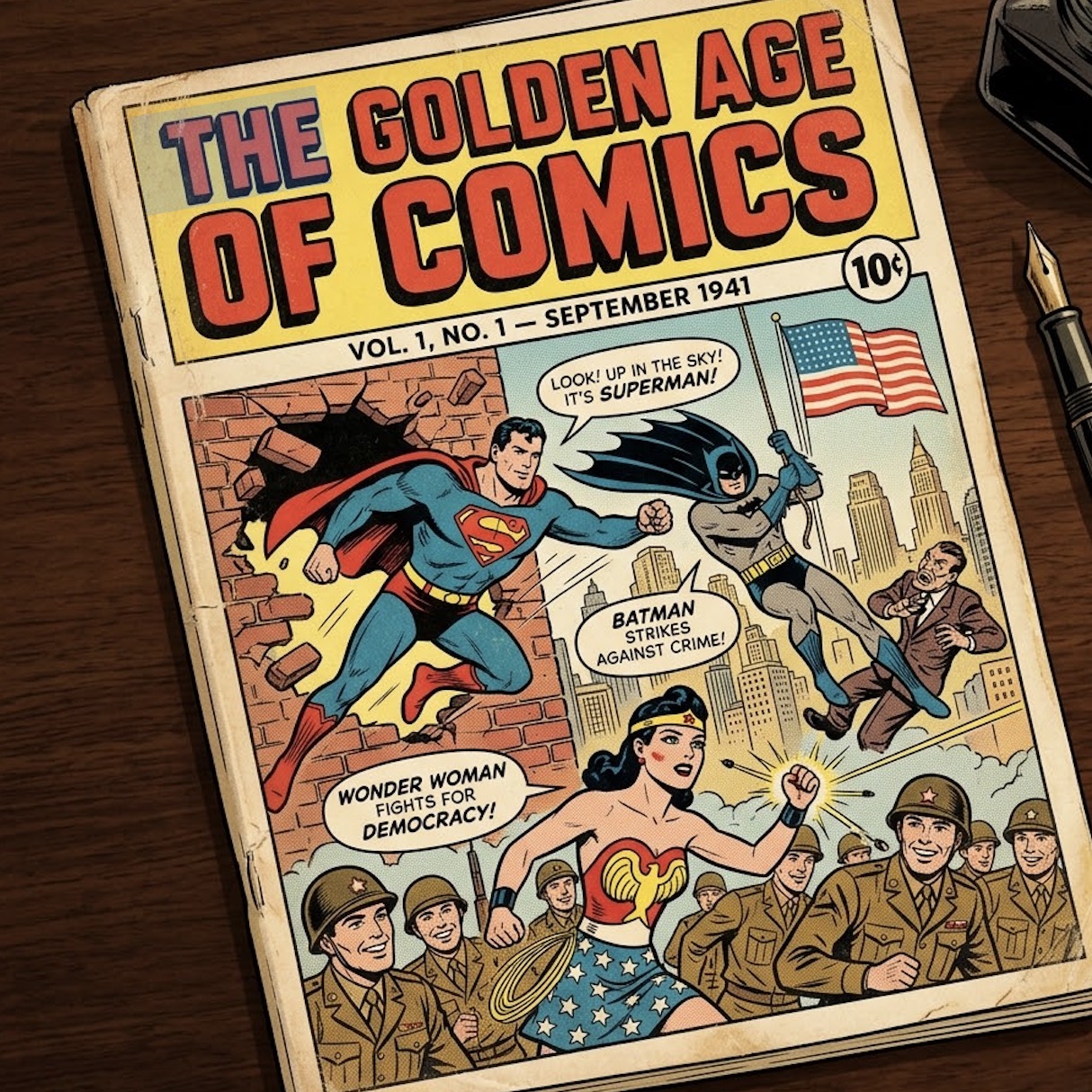
The Golden Age of Comics (1938–1954) launched with the debut of Superman in Action Comics #1, creating the superhero archetype and spawning a massive, overnight entertainment industry.
Unlike the polished editorial control of the Silver Age, the Golden Age was defined by the “Studio System.” Independent comic packagers (like the Eisner & Iger Studio) operated as high-volume sweatshops where young, hungry creators—many of them first-generation immigrants—churned out pages at breakneck speed to feed publishers hungry for new content.
The Architect Writers
Golden Age writers had to invent the tropes of the superhero genre from scratch. They pulled heavily from pulp magazines, science fiction, and mythological archetypes to build characters that would endure for nearly a century.
-
Jerry Siegel: The visionary co-creator of Superman. Siegel injected his love of sci-fi fanzines into the comic medium, establishing the core tenets of the superhero: the secret identity, the colorful costume, and the tragic origin story. He also co-created the supernatural vengeance hero, The Spectre.
-
Bill Finger: The unsung architect of Gotham City. While Bob Kane took sole credit for decades, Finger was the writer who actually designed Batman’s costume, named Bruce Wayne, and co-created the Joker, Catwoman, Robin, and Commissioner Gordon. Finger’s writing brought a darker, pulp-detective atmosphere to comics that contrasted sharply with Superman.
-
William Moulton Marston: A Harvard-trained psychologist (and inventor of an early lie detector), Marston created Wonder Woman to serve as a feminist icon. His scripts were highly unconventional, weaving his theories on psychological submission, bondage, and matriarchal utopias into superhero adventures.
-
Otto Binder: The definitive writer for Fawcett Comics’ Captain Marvel (Shazam). Binder wrote over half of the entire Captain Marvel run, infusing the stories with a whimsical, fairy-tale logic that appealed directly to children. Under Binder’s pen, Captain Marvel outsold Superman throughout the 1940s.
The Master Artists
Golden Age art was initially crude and rushed, but it rapidly evolved as artists pushed the boundaries of what a sequential page could communicate.
-
Joe Shuster: The co-creator and original artist of Superman. Shuster’s style was raw, kinetic, and stripped-down, heavily influenced by newspaper adventure strips. His ability to convey the sheer force and speed of Superman set the baseline for how super-strength was depicted on the page.
-
Will Eisner: The medium’s first true cinematic director. Creating The Spirit as a weekly newspaper insert, Eisner pioneered dramatic lighting, film noir camera angles, and splash pages where the title lettering was built directly into the scenery. He viewed comics as a legitimate art form (“sequential art”) rather than disposable entertainment.
-
Jack Kirby: Before defining the Marvel Age, a young Kirby co-created Captain America with Joe Simon. Kirby immediately broke the rigid grid structure of comic pages, drawing characters bursting out of panels and throwing punches straight at the reader. His cover of Captain America Comics #1 (punching Adolf Hitler) remains one of the most famous images in comic history.
-
C.C. Beck: The chief artist and co-creator of Captain Marvel. Beck employed a clean, rounded, highly legible cartooning style. He rejected the heavy shadows and gritty realism creeping into other books, believing comics should remain fundamentally fun and easy to read.
-
Lou Fine & Mac Raboy: The premium draftsmen of the era. Fine (who drew The Ray and Black Condor) and Raboy (who drew Captain Marvel Jr.) brought precise anatomical rendering and classical illustration techniques to comics. Their work was heavily studied by the generation of artists that followed.
The Auteurs & Industry Shakers
Some creators defied the assembly-line nature of the Golden Age, taking complete control of their characters and pushing the medium into new genres.
| Creator | Dual Role | Defining Golden Age Contribution |
| Joe Simon | Writer / Artist / Editor | The ultimate business-savvy creator. Partnering with Jack Kirby, Simon co-created Captain America, negotiated unprecedented royalty deals, and literally invented the Romance comic genre (Young Romance) after superhero sales slumped post-WWII. |
| Jack Cole | Writer / Artist | Creator of Plastic Man. Cole brought a frantic, surreal, and deeply comedic elasticity to his layouts. His panels stretched and warped along with his protagonist, introducing a sense of madcap physical comedy to the superhero genre. |
| Carl Barks | Writer / Artist | “The Good Duck Artist.” Working in total anonymity for Disney comics, Barks created Uncle Scrooge, Duckburg, and the Beagle Boys. His immaculately researched, globe-trotting adventure stories heavily influenced creators from George Lucas to Osamu Tezuka. |
| Fletcher Hanks | Writer / Artist | An outsider auteur who created bizarre, intensely violent, and surreal characters like Stardust the Super Wizard. Hanks drew and wrote completely alone, producing a body of work that feels like fever-dream outsider art compared to his peers. |

