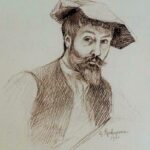

Hector-Germain Guimard (Spouse: Adeline Oppenheim, a painter) was the preeminent architect and designer of the French Art Nouveau movement. His work was defined by a radical rejection of classical symmetry in favor of “biomorphic” forms—designs that mimicked the fluid, organic curves of vines, flowers, and stems. Guimard believed that every element of a building, from the structural ironwork to the furniture and door handles, should form a unified, living organism.
Born in Lyon, Guimard studied at the École des Arts Décoratifs in Paris. His early career was standard until 1894, when he visited the Hôtel Tassel in Brussels, designed by Victor Horta. This encounter with Horta’s revolutionary, flowing interiors transformed Guimard’s vision. Shortly after, he began work on the Castel Béranger in Paris (1895–1898), an apartment building that became the manifesto of French Art Nouveau. Every detail, from the wrought-iron gates to the wallpaper, featured his signature “whiplash” curves and asymmetrical compositions.
Guimard’s most iconic contribution to the Paris cityscape remains the Paris Métro entrances. Between 1899 and 1904, he designed 141 entrance structures using cast iron, glass, and ceramic, styled to resemble exotic, alien plant life. These structures were controversial at the time but are now recognized as the definitive visual identity of Belle Époque Paris.
As the Art Nouveau style fell out of fashion before World War I, Guimard turned toward standardized, pre-fabricated housing designs, hoping to make high-quality, beautiful architecture accessible to the middle class. However, his work was largely forgotten by the public until a major retrospective in the 1970s. Today, he is revered as a visionary who blurred the lines between architecture, sculpture, and industrial design.
Active in others filds :
Industrial Design (Furniture, Jewelry, and Ceramic design), Urban Planning.
Hector Guimard Legacy :
Guimard’s legacy is synonymous with the “Style Métro.” He proved that industrial materials like cast iron and glass could be manipulated to express the beauty of nature, a concept that influenced later movements like Surrealism and modern organic architecture. While many of his buildings were demolished in the mid-20th century, his surviving works are now protected as national treasures.
He was heavily influenced by the Belgian architect Victor Horta, the pioneer of Art Nouveau. Guimard’s focus on total design (the Gesamtkunstwerk) aligns him with contemporaries like William Morris and Antoni Gaudí, though Guimard’s work is distinct for its lighter, more ethereal ironwork.