




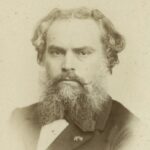
Henri Marie Raymond de Toulouse-Lautrec-Monfa (Parents: Count Alphonse and Countess Adèle de Toulouse-Lautrec) was a towering, if physically diminished, figure of the Parisian Belle Époque. Born into an ancient aristocratic family, his life was irrevocably altered by genetic health issues—likely resulting from the consanguineous marriage of his parents—which caused his legs to stop growing during his teenage years. Standing at only 1.52 meters (approx. 5 feet) as an adult, he found solace and eventually a career in the bohemian world of Montmartre.
Rejecting the rigid traditionalism of his family, Lautrec immersed himself in the cabaret culture of late 19th-century Paris. He became the chronicler of the night, capturing the dancers, prostitutes, performers, and social outcasts of the Moulin Rouge, Le Chat Noir, and the dance halls of the district. His style was defined by expressive, swift brushwork, bold colors, and unconventional, photographic-like cropping influenced by the emerging art of Japanese ukiyo-e prints.
Beyond his paintings, Lautrec was a revolutionary in the field of graphic design and lithography. His posters, particularly those created for the entertainer Jane Avril and the singer Aristide Bruant, transformed the streets of Paris into an open-air art gallery. He brought a sense of graphic immediacy to the medium, using simplified shapes and strong silhouettes that would go on to define the visual language of the Art Nouveau movement. Despite his prolific output, his life was marked by alcoholism and declining health, leading to his premature death at the age of 36.
Active in others filds :
Graphic Design, Poster Art, Lithography, Illustration (for various Parisian journals).
Henri de Toulouse-Lautrec Legacy :
Lautrec died young, but his impact on modern visual culture is immeasurable. He is credited with elevating the commercial poster to the status of “fine art.” His ability to distill a subject’s personality into a few sharp, suggestive lines influenced the development of caricature and modern editorial illustration. His legacy remains immortalized as the man who captured the ephemeral, glittering, and gritty soul of late-Victorian Paris.
Toulouse-Lautrec was heavily inspired by the works of Edgar Degas, whose influence can be seen in Lautrec’s interest in unconventional perspectives and themes of performance and isolation. He also maintained a close, albeit complex, friendship with Vincent van Gogh, whom he met in the studio of Fernand Cormon; Lautrec notably defended Van Gogh during a confrontation in a café, and his sensitive pastel portrait of Van Gogh remains one of the most intimate depictions of the Dutch master from that era.



