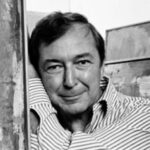

Paul Jackson Pollock (Spouse: Lee Krasner; Father: LeRoy Pollock; Mother: Stella May McClure) was a leading force in the Abstract Expressionism movement and one of the most famous and influential American painters of the 20th century. Born in Wyoming and raised across the American West, he later moved to New York City to study under the Regionalist painter Thomas Hart Benton at the Art Students League. However, Pollock soon moved away from traditional representation, drawing deep inspiration from Mexican muralists, Surrealist automatism, and Native American sand painting.
Pollock is most celebrated for pioneering the “drip technique” (or Action Painting). Around 1947, he began working in a radical new way: he abandoned the easel, placed massive unstretched canvases on the floor of his barn studio in Springs, New York, and used hardened brushes, sticks, and syringes to drip, pour, and fling synthetic resin-based enamel paints from all sides. This physical, performative method of painting treated the canvas as an arena for action, capturing the kinetic energy and emotional state of the artist rather than illustrating a specific subject.
In 1945, he married fellow abstract painter Lee Krasner, who became a profound influence on his career, managing his estate and fiercely championing his work. His radical style brought him intense media attention, culminating in a famous 1949 Life magazine spread that asked, “Is he the greatest living painter in the United States?” Despite his massive success, Pollock wrestled severely with volatile mood swings and chronic alcoholism throughout his life. His life was cut tragically short at the age of 44 when he died in a single-car crash while driving under the influence of alcohol.
Active in others filds :
Printmaking, Lithography, Drawing.
Notable Collaborations :
Pollock’s most significant lifelong collaboration and intellectual exchange was with his wife, painter Lee Krasner. He also worked closely with legendary art collector and patron Peggy Guggenheim (who commissioned his breakthrough work, Mural, and gave him his first solo exhibition), the influential Mexican muralist David Alfaro Siqueiros (in whose experimental workshop Pollock first used liquid paint), and the prominent art critic Clement Greenberg, who vigorously championed Pollock’s work to the public.
Jackson Pollock Legacy :
Pollock’s legacy is monumental; he is widely credited with helping shift the center of the avant-garde art world from Paris to New York after World War II. By shattering the conventions of traditional painting techniques and compositional boundaries, he expanded the definition of what art could be. Today, he remains the archetype of the tormented, revolutionary modern artist, and his chaotic, mesmerizing canvases are considered crowning achievements of the Abstract Expressionist movement, commanding record-breaking prices at international auctions.
Selected Notable Works :
Mural (1943), The She-Wolf (1943), Full Fathom Five (1947), Number 1A, 1948 (1948), Number 5, 1948 (1948), Autumn Rhythm (Number 30) (1950), Lavender Mist (Number 1) (1950), One: Number 31, 1950 (1950), Convergence (1952), Blue Poles (Number 11, 1952) (1952), The Deep (1953)
Awards and Honors :
(Pollock generally eschewed traditional art competitions, and his major honors were largely cultural and posthumous.) Selected to represent the United States at the Venice Biennale (1950), Memorial Retrospective Exhibition at The Museum of Modern Art (MoMA) in New York (1956), Comprehensive Retrospective at MoMA (1967), Posthumous comprehensive retrospectives at the Tate Gallery (London) and Centre Pompidou (Paris).
Exhibitions & Art Venues :
The Museum of Modern Art (MoMA), Solomon R. Guggenheim Museum, Tate Modern, National Gallery of Art (Washington D.C.), Centre Pompidou, Metropolitan Museum of Art, Art Institute of Chicago, San Francisco Museum of Modern Art (SFMOMA), Peggy Guggenheim Collection, Los Angeles County Museum of Art (LACMA)