
Cgitems Logo
Entering
Simone Martini
Loading Encyclopedia...
Connecting to Cgitems Server...
Thanks for your patience
Simone Martini - CGItems
☆
  • UK - English UK - English
  • France - Français France - Français
  • Germany - Deutsch Germany - Deutsch
  • Netherlands - Nederlands Netherlands - Nederlands
  • Norway - Norsk Norway - Norsk
  • Denmark - Dansk Denmark - Dansk
  • Finland - Suomi Finland - Suomi
  • Vietnam - Tiếng Việt Vietnam - Tiếng Việt
  • Italy - Italiano Italy - Italiano
  • Sweden - Svenska Sweden - Svenska
  • Brazil - Português Brazil - Português
  • Greece - Ελληνικά Greece - Ελληνικά
  • Thailand - ไทย Thailand - ไทย
  • Iran - فارسی Iran - فارسی
  • Arab - العربية Arab - العربية
  • Spain - Español Spain - Español
  • China - 中文 China - 中文
  • Turkey - Türkçe Turkey - Türkçe
  • Russia - Русский Russia - Русский
  • South Korea - 한국어 South Korea - 한국어
  • Japan - 日本語 Japan - 日本語
  • India - हिन्दी India - हिन्दी
SUB CATEGORIES
×

Medieval paintings were often sumptuous objects made with gold and other precious materials. What made these paintings valuable were these materials (blue, for example, was often made from the rare and expensive semi-precious stone, Lapis Lazuli). These materials were lavished on objects to express religious devotion or to reflect the wealth and status of its patron. Today the value of a painting is often the result of something entirely different. Picasso could have painted on a napkin and it would have been incredibly valuable just because it was by Picasso—art is now an expression of the artist and materials often have little to do with the worth of the art.

More Info : Here

Name : Simone Martini

Born : 1284

Died : 1344

Art Style & Movement : Gothic

Main Field/s : , ,

SUB CATEGORIES
×

Keep Reading About

Simone Martini

Simone Martini (c. 1284 – 1344) was an Italian painter born in Siena. He was a major figure in the development of early Italian painting and greatly influenced the development of the International Gothic style.

It is thought that Martini was a pupil of Duccio di Buoninsegna, the leading Sienese painter of his time. According to late Renaissance art biographer Giorgio Vasari, Simone was instead a pupil of Giotto di Bondone, with whom he went to Rome to paint at the Old St. Peter’s Basilica, Giotto also executing a mosaic there. Martini’s brother-in-law was the artist Lippo Memmi. Very little documentation of Simone’s life survives, and many attributions are debated by art historians. According to E. H. Gombrich, he was a friend of Petrarch and had painted a portrait of Laura.

Simone was doubtlessly apprenticed from an early age, as would have been the normal practice. Among his first documented works is the Maestà of 1315 in the Palazzo Pubblico in Siena.[1] A copy of the work, executed shortly thereafter by Lippo Memmi in San Gimignano, testifies to the enduring influence Simone’s prototypes would have on other artists throughout the 14th century. Perpetuating the Sienese tradition, Simone’s style contrasted with the sobriety and monumentality of Florentine art, and is noted for its soft, stylized, decorative features, sinuosity of line, and courtly elegance. Simone’s art owes much to French manuscript illumination and ivory carving: examples of such art were brought to Siena in the fourteenth century by means of the Via Francigena, a main pilgrimage and trade route from Northern Europe to Rome.

Simone’s other major works include the Saint Louis of Toulouse Crowning His Brother Robert of Anjou (1317, now Museo di Capodimonte, Naples); this work was painted during a stay in Naples at the request of the king. During this stay, putative pupils were his son Francesco, Gennaro di Cola, and Stefanone.[2][3]

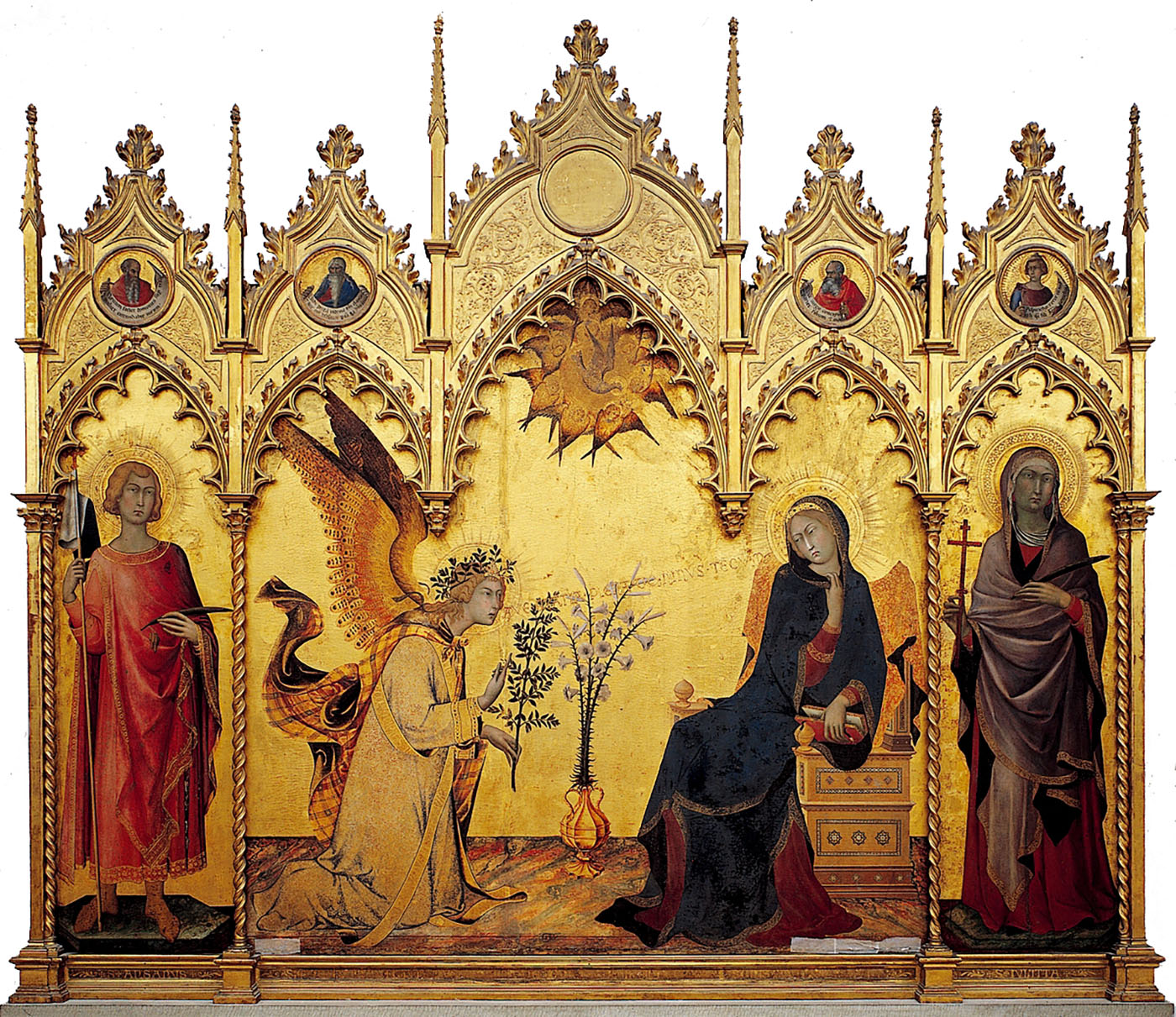
Among other of Simone’s works, he also painted the Saint Catherine of Alexandria Polyptych in Pisa (1319) and the Annunciation with St. Margaret and St. Ansanus at the Uffizi in Florence (1333), as well as frescoes in the San Martino Chapel[1] in the lower church of the Basilica of San Francesco d’Assisi. Francis Petrarch became a friend of Simone’s while in Avignon, and two of Petrarch’s sonnets (Canzoniere 96 and 130) make reference to a portrait of Laura de Noves that Simone supposedly painted for the poet (according to Vasari). A Christ Discovered in the Temple (1342) is in the collections of Liverpool’s Walker Art Gallery.

Simone Martini died while in the service of the Papal court at Avignon in 1344.

Simone Martini

Related Style

Related Artists

Hans Holbein the elder
Leonardo Da Vinci
Tintoretto
Sandro Botticelli
Cimabue
Giovanni Pisano
SUB CATEGORIES
×

Find Other Master Artists

1780

1867

Artist Directory

Please correct the dates: "From Year" must be less than or equal to "To Year".

Explore More

The Realm of Analog Artistry

This curated space is dedicated to the timeless works of global master artists, created through traditional mediums and manual precision. From fine oil paintings to architectural drafting, every piece represents the authentic tactile heritage of visual arts .

Help us keep the CGItems Art Encyclopedia precise and complete. If any featured artist's portfolio is missing, or if an entry requires review or visual updates, please contact us so we can review and update the content accordingly.

Artist ID : 25387

Last Update : September 11, 2026

Reset to Default
+ FAVORITES ✎
✕
⋮ ☆ Simone Martini
✕
HELP AGENT
PLEASE WAIT, LOADING...
×
MCA

--
Analyzing image & extracting data...

Link Copied!

General Inquiry

Have a question or feedback regarding portfolios? Drop us a line.

Strictly plain English text structure only.

Attachments Inventory

Max 500KB per file. Max 10 images.

Delivery Confirmed

Thank you. Your message and data structural packages have been safely transferred to our desk.

Artist Name Artwork Details
Search with Google Lens
Print...
