Cgitems Logo
Entering
Art Movements
Loading Encyclopedia...
Connecting to Cgitems Server...
Thanks for your patience
Art Movements - CGItems
☆
  • UK - English UK - English
  • France - Français France - Français
  • Germany - Deutsch Germany - Deutsch
  • Netherlands - Nederlands Netherlands - Nederlands
  • Norway - Norsk Norway - Norsk
  • Denmark - Dansk Denmark - Dansk
  • Finland - Suomi Finland - Suomi
  • Vietnam - Tiếng Việt Vietnam - Tiếng Việt
  • Italy - Italiano Italy - Italiano
  • Sweden - Svenska Sweden - Svenska
  • Brazil - Português Brazil - Português
  • Greece - Ελληνικά Greece - Ελληνικά
  • Thailand - ไทย Thailand - ไทย
  • Iran - فارسی Iran - فارسی
  • Arab - العربية Arab - العربية
  • Spain - Español Spain - Español
  • China - 中文 China - 中文
  • Turkey - Türkçe Turkey - Türkçe
  • Russia - Русский Russia - Русский
  • South Korea - 한국어 South Korea - 한국어
  • Japan - 日本語 Japan - 日本語
  • India - हिन्दी India - हिन्दी

Visual Art Encyclopedia & Galleria

SUB CATEGORIES
×

Sculpting

Available Art Style , Movement & Technique

The Art Movements section here is a comprehensive encyclopedia uniting movements, styles, execution techniques, related artists, artworks, and deep historical context into a single dynamic platform bridging classical art and modern digital creation. Every movement and style features a dedicated, comprehensive page, such as Impressionism, designed for thorough study and exploration.

Art Movements 1

Select Art Styles & Movements

Classicism

Classicism refers to the high regard for classical antiquity—specifically the art, architecture, and literature of Ancient Greece and Rome. It is the aesthetic of order, balance, and ideal proportion. While it originated in antiquity, “Classicism” as an art movement often refers to the periodic revivals (such as the Renaissance and Neoclassicism) that sought to recapture these ancient standards.

In the visual arts, Classicism prioritizes the “Ideal.” Rather than depicting life with all its flaws, Classicist artists sought to represent the perfect version of nature. This involves a focus on anatomical perfection, clear linear perspective, and a sense of “noble simplicity and quiet grandeur.” Every element in a Classicist work is intentionally placed to create a harmonious whole, avoiding the chaotic emotion seen in later movements like Romanticism.

Fantasy art

Fantasy Art is a broad, highly influential visual genre characterized by the depiction of mythic, supernatural, magical, or speculative themes that exist outside the boundaries of our consensus reality. It is an art form rooted in world-building, where the impossible is rendered with enough structural and material logic to suspend the viewer’s disbelief. Unlike abstract art, Fantasy Art typically relies on Representational Realism or Academic Realism to ground its impossible subjects—such as mythical creatures, ancient sorcery, invented landscapes, and legendary heroes—in a tangible, believable environment.

For researchers, historians, and digital artists, Fantasy Art is understood through several distinct sub-movements and technical evolutions:

  • The Mythological & Romantic Roots: Early foundations heavily borrowed from the Pre-Raphaelites and Symbolists, focusing on folklore, Arthurian legends, and classical mythology with a soft, idealized, and romanticized lens.

  • The Pulp & Sword-and-Sorcery Era (Mid-20th Century): Dominated by paperback book covers and magazines. This phase introduced hyper-muscular anatomy, dynamic kinetic energy, and raw, visceral action compositions.

  • Contemporary High Fantasy & Imaginative Realism: The modern phase blends classical oil painting techniques with advanced digital tools, emphasizing complex ecosystem designs, cultural anthropology for fictional races, and highly sophisticated atmospheric lighting.

Relief

Relief is a sculptural technique where sculpted elements remain attached to a solid background of the same material. Rather than creating a fully free-standing three-dimensional object (sculpture in the round), the artist gives the impression that the sculpted material has been raised above the background plane or carved into it.

In academic and historical research, relief art is categorized into four distinct technical classifications based on depth:

  • Bas-Relief (Low Relief / Basso-Rilievo): The figures project slightly from the background with minimal undercutting (e.g., coins, ancient Egyptian wall carvings).

  • Alto-Relief (High Relief / Alto-Rilievo): Figures project at least half or more of their natural depth from the background plane, often with limbs fully undercut and separated from the backing wall.

  • Rilievo Schiacciato (Flattened Relief): Pioneered during the Renaissance, this ultra-shallow technique uses microscopic gradations of depth and linear perspective to create the illusion of atmospheric spatial depth on a nearly flat surface.

  • Sunken Relief (Intaglio / Incised Relief): The image is carved below the level of the surrounding flat surface, preserving the flat outline of the block (prominent in ancient Egyptian temple walls).

Chiaroscuro

Chiaroscuro (from the Italian chiaro “light” and scuro “dark”) is a technical term used to describe the use of strong contrasts between light and dark to give the illusion of three-dimensional volume on a two-dimensional surface. It is more than just “adding shadows”; it is a method of modeling form through the graduation of tone.

While Tenebrism (a sub-style popularized by Caravaggio) uses darkness as a dominant, “pitch-black” background for dramatic effect, classical Chiaroscuro is more focused on the soft transition of light across a form to create “solidity.” In the context of visual arts, it transformed the flat, symbolic paintings of the Middle Ages into the fleshy, realistic figures of the Renaissance.

Note on Modern Distinction: In this entry, we focus on the Classical/Painterly foundation. While “Film Noir” and “Comic Noir” use Chiaroscuro principles, they are distinct modern evolutions that prioritize stylized, high-contrast “hard” edges over the soft “atmospheric” transitions seen in classical oil painting.

Chiaroscuro Lighting & Style , Artwork By Caravaggio

Neoclassicism

Neoclassicism was a Western cultural movement in the decorative and visual arts, literature, theater, music, and architecture that drew inspiration from the “classical” art and culture of Classical Antiquity. It emerged as a direct reaction against the excessive ornamentation of the Rococo style and the emotional intensity of the Baroque.

For researchers and students, the hallmark of Neoclassicism is restraint. In painting, this meant a return to sharp outlines, cool colors, and “invisible” brushwork, making the surface appear as smooth as marble. The compositions are typically symmetrical and organized, resembling a stage play. It prioritized “line” over “color,” believing that clear drawing represented intellectual clarity, whereas messy color represented base emotions.

Symbolism

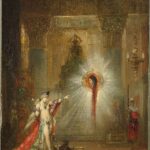
Symbolism was a late 19th-century movement that rejected the literal representation of the world (Realism and Impressionism) in favor of the inner life of the mind. Symbolist artists did not aim to paint a tree or a person as they appeared to the eye, but rather as symbols of a deeper, often darker, psychological or spiritual reality.

It is characterized by an interest in the occult, dreams, melancholy, and the macabre. For researchers, it is the bridge between the Romanticism of the early 1800s and the Surrealism of the 20th century. The art is intentionally ambiguous; it uses “private” symbols—motifs that might mean something specific to the artist but remain mysterious to the viewer—to evoke a mood or a “state of soul” rather than a clear narrative.

Line art

Line Art is one of the most fundamental, ancient, and enduring forms of visual communication. By definition, it consists of distinct straight or curved lines placed against a (usually plain) background, completely omitting strong gradations of shade (chiaroscuro) or color to represent two-dimensional or three-dimensional objects. It relies entirely on the eye’s ability to interpret structural boundaries, edges, and form through contour alone.

For researchers, designers, and students, Line Art is not merely a single “style” but a foundational discipline that spans millennia and branches into distinct technical variations:

  • Pure Contour Drawing: Focuses solely on the external edge of an object, using a continuous, unweighted line to define the boundary between form and space.

  • Weighted/Varied Line Art: Utilizes changes in line thickness (tapering and swelling) to suggest depth, light source, shadow, and structural mass without using actual gradients.

  • Cross-Hatching and Stippling: Techniques where form, density, and value are built up using clusters of parallel lines (hatching), intersecting lines (cross-hatching), or dots (stippling).

  • Technical & Blueprint Line Art: Orthographic projections, architectural schematics, and vector-based diagrams where line weight dictates structural hierarchy, material thickness, or hidden lines rather than artistic expression.

This drawing is Pablo Picasso's 1920 portrait of the composer Igor Stravinsky
This drawing is Pablo Picasso’s 1920 portrait of the composer Igor Stravinsky

Because it strips away the “distraction” of color and rendering, Line Art forces an emphasis on composition, gesture, silhouette, and absolute precision. A single misplaced line can alter the entire anatomy or perspective of a piece.

Realism

Realism was a pivotal 19th-century movement that acted as a “truth-telling” force in art. It emerged as a direct rejection of Romanticism (which exaggerated emotion) and Neoclassicism (which idealized history). Realism insisted on depicting the world exactly as it was—warts and all—focusing on the mundane, the gritty, and the everyday lives of the working class.

For researchers and students, it is crucial to distinguish between Artistic Realism (the movement) and Photorealism (the technical ability to mimic a photo). Realism wasn’t just about “looking real”; it was about “being honest.” Realist painters refused to paint angels or Greek gods because, as Gustave Courbet famously said, “I have never seen an angel. Show me an angel, and I will paint one.” This movement laid the essential groundwork for Impressionism and all subsequent modern art by breaking the rules of what was considered “worthy” of being painted.

Street Art

Street Art is an expansive visual art movement created in public spaces, historically executed outside the context of traditional art venues. What began as a rebellious, underground graffiti subculture—characterized by tagging and claiming urban territory—has evolved into a globally recognized, highly diverse art form. Unlike traditional gallery art, Street Art is inherently ephemeral, often subject to weathering, removal by authorities, or being painted over by other artists.

The movement encompasses a wide range of practices, from freehand aerosol murals and intricate stencil work to wheatpasting, sticker bombing (slaps), and mosaic installations. Street Art challenges the boundaries of property, legality, and public discourse, turning city walls into open-air canvases. While early graffiti was primarily typographic and focused on the artist’s moniker, modern street art is highly illustrative, often tackling political, social, or environmental issues through subversion, dark humor, and pop-culture appropriation.

CGItem Street Girl - Street Art
Street Art Girl (leda)

Victorian

The Victorian era (spanning Queen Victoria’s reign from 1837 to 1901) represents a transformative period in visual history, marked by rapid industrialization, imperial expansion, technological leaps, and intense social stratification. Visually, “Victorian Style” is not a single aesthetic, but an umbrella movement characterized by eclecticism, ornate historical revivals, high ornamental density, and narrative moralism.

Across various visual disciplines, the style manifests through distinct sub-movements and mediums:

  • Painting & Illustration: Ranging from narrative genre scenes of high society and moral dilemmas to the luminous, medievalist rebellion of the Pre-Raphaelite Brotherhood (PRB) and the mood-focused Aesthetic Movement.

  • Architecture: Characterized by dramatic historicism—predominantly Gothic Revival, Queen Anne Style, and Italianate, alongside structural iron-and-glass engineering (such as Joseph Paxton’s Crystal Palace).

  • Interior Design: Heavily layered and ornamental, featuring dark wood paneling, flock wallpaper (pioneered by William Morris), tufted velvet upholstery, brass, stained glass, and clashing floral patterns.

  • Fashion: Highly structured silhouettes reflecting social status; defined by tight corsetry, massive crinolines (later evolving into bustles), rich silks, lace collars, mourning wear, and early synthetic aniline dyes (mauveine).

  • Photography: The birthplace of early commercial and fine-art photography, evolving from daguerreotypes and salted paper prints to wet-plate collodion portraits, combination printing, and early photojournalism.

Architectural

Architectural movements represent the evolution of human civilization through the lens of Form, Function, and Material. Unlike isolated art movements, architecture is bound by the laws of physics and the socio-economic needs of the time. A “Movement” in architecture is defined by a shared vocabulary of structural elements (how it stands up) and aesthetic ornamentation (how it looks).

For the Cgitems database, architectural movements are analyzed through three primary lenses:

  • Structural Innovation: The transition from Post-and-Lintel (Ancient) to Arches/Vaults (Medieval) to Steel Frames (Modern) and finally to Computational/Parametric design.

  • Spatial Philosophy: How a building treats the person inside—from the intimidating “divine scale” of the Gothic era to the “human-centric” ergonomics of Modernism.

  • The Facade & Envelope: The “skin” of the building, which reflects the artistic trends of the era, such as the intricate carvings of the Baroque or the “Glass Curtain Walls” of the International Style.

Figurative

Figurative art (or Figurativism) encompasses any form of visual artwork—paintings, sculptures, graphic arts, or digital media—that retains strong, recognizable references to real-world objects, subjects, and specifically the human body. Unlike pure abstraction (which operates entirely through non-representational form, color, and line), figurative art uses spatial illusion, anatomical proportions, lighting, and narrative structures to visually anchor the subject in recognizable reality.

Historically, figurative art served as the central engine of human artistic production—from paleolithic cave paintings and classical marble portraiture to high-Renaissance humanism and modern psychological expressionism. In modern art theory, “figurative” does not merely denote photo-realism; rather, it describes a spectrum that ranges from strict naturalism to distorted, stylized, or expressive representational form. The core requirement is that the human or physical figure remains the primary structural and narrative axis of the artwork.

Aestheticism

Aestheticism—often encapsulated by the famous French rallying cry “L’art pour l’art” (“Art for Art’s Sake”)—was a revolutionary late-19th-century avant-garde movement. It shook the foundation of Victorian culture by aggressively rejecting the idea that art must serve a moral, didactic, social, or political purpose. To the Aesthete, art didn’t need to tell a story, teach a lesson, or reform society; its sole justification was the pursuit of pure, sensual beauty and visual pleasure.

William Blake Richmond Artwork

For researchers and art students, the movement is defined by its deep intellectualism and intense focus on formal qualities over narrative content. It treated composition as a purely musical arrangement where lines, colors, and textures interact to evoke a mood. The movement heavily rebelled against industrial mass production and the “gaudy” or “stuffy” interior designs of the high Victorian era, seeking instead to cultivate an entirely beautiful lifestyle. Rather than treating nature as the ultimate ideal, Aesthetes often viewed nature as crude, unfinished, and lacking design until refined by human artistic intelligence.


A major catalyst for this style was Japonisme (the late-19th-century craze for Japanese art). The sudden influx of Japanese woodblock prints and decorative screens provided artists with alternative design principles: flat planes of color, radical asymmetry, stylized natural motifs, and a refined sense of decorative spacing that bypassed traditional Western perspective.

Manga

Manga (漫画) is a sophisticated Japanese sequential art form that evolved from 12th-century scrolls into a global cultural phenomenon. Unlike Western comics, Manga is a multi-generational medium with specific demographic classifications: Shonen (young males), Shojo (young females), Seinen (adult men), and Josei (adult women).

Technically, Manga is defined by its “cinematic” pacing. While Western comics often focus on action-to-action transitions, Manga frequently uses aspect-to-aspect transitions—lingering on a falling leaf or a background detail to establish mood or “Ma” (the interval of empty space). The style relies heavily on a specialized vocabulary of visual symbols, such as “sweat drops” for anxiety or “popping veins” for anger. For researchers, the core of Manga’s power lies in its Iconic Abstraction: characters are drawn with simplified, expressive features (large eyes, minimal noses) to allow the reader to project themselves onto the character more easily.

Architectural

Classical Architecture refers to the highly structured, formalized building traditions derived from ancient Greece and Rome. It is a style dictated by sacred geometry, mathematical ratios, and a strict adherence to symmetry. Rather than merely being a historical era, Classical Architecture is a comprehensive design system that has been revived, adapted, and reinterpreted across millennia (through the Renaissance, Neoclassicism, and Beaux-Arts movements).

The cornerstone of the system is the Architectural Order. An Order dictates the specific shape, proportions, and decoration of the column, its base, its capital (the top of the column), and the entablature (the horizontal superstructure sitting on top). For students and researchers, the system is divided into five definitive canonical orders:

  • Doric: The oldest, simplest, and sturdiest order, featuring a plain capital and no base (Greek Doric) or a simple base (Roman Doric).

  • Ionic: Characterized by elegant, slender proportions and a capital decorated with spiral, scroll-like carvings called volutes.

  • Corinthian: The most ornate style, featuring an elongated capital intricately carved with stylized acanthus leaves.

  • Tuscan: A simplified, unfluted Roman adaptation of the Doric order.

  • Composite: A rich Roman combination of the Ionic volutes and Corinthian acanthus leaves.

A core concept in Classical Architecture is entasis—the subtle, intentional swelling or curving of a column’s shaft. Classical architects discovered that perfectly straight columns appear to bow inward when viewed from a distance due to an optical illusion. Entasis corrects this, making the columns appear perfectly straight, rigid, and organically alive under the heavy weight they support.

High Renaissance

The High Renaissance represents the absolute peak of artistic achievement, mathematical harmony, and humanistic idealization in Western art. Centered primarily in Rome and Venice after originating in Florence, this short-lived period refined the technical breakthroughs of the Early Renaissance—such as linear perspective and anatomical accuracy—into a unified aesthetic of perfect balance, ideal proportion, and monumental scale.

For researchers, students, and digital artists, the High Renaissance is defined by three fundamental pillars:

  • Disegno vs. Colore: The divide between Florence/Rome (emphasizing precise line, structural drawing, and anatomical geometry) and Venice (emphasizing atmospheric color, tone, and expressive brushwork).

  • Atmospheric Mastery: The refinement of Sfumato (delicate, imperceptible blending of tones without sharp borders) and Chiaroscuro (dramatic contrast between light and dark to build 3D mass).

  • Idealized Naturalism: Moving past stiff realism to create forms that represent perfect, divine versions of human anatomy and natural environments, heavily influenced by Classical Greco-Roman antiquity.

Art Movements 1

Quick Look

Fine Art Directory ( Highlight )

Peter Paul Rubens

Reset to Default
+ FAVORITES ✎
✕
⋮ ☆ Art Movements
✕
HELP AGENT
PLEASE WAIT, LOADING...
×
MCA

--
Analyzing image & extracting data...

Link Copied!

General Inquiry

Have a question or feedback regarding portfolios? Drop us a line.

Strictly plain English text structure only.

Attachments Inventory

Max 500KB per file. Max 10 images.

Delivery Confirmed

Thank you. Your message and data structural packages have been safely transferred to our desk.

Artist Name Artwork Details
Search with Google Lens
Print...