


Umberto Boccioni (Parents: Raffaele Boccioni, a minor government official, and Cecilia Forlani)
Umberto Boccioni (1882–1916) was a brilliant and highly influential Italian painter and sculptor who became the primary visual theorist and driving force behind the Futurist movement. His work fundamentally reshaped the trajectory of modern art by seeking to capture the energy, speed, violence, and technological dynamism of the 20th century.
Born in southern Italy, Boccioni traveled extensively before settling in Milan in 1907. Milan was Italy’s industrial heart, and its rapid modernization profoundly influenced him. In 1910, after meeting Filippo Tommaso Marinetti, the poet who founded Futurism, Boccioni co-authored the Manifesto of Futurist Painters. He urged artists to abandon the heavy burden of Italy’s classical past and instead embrace the “feverish” and “simultaneous” nature of the modern, industrial city.
Initially rooted in Divisionism (a style using distinct dots or strokes of color), Boccioni’s art evolved dramatically after he visited Paris in 1911. Exposure to Cubism allowed him to shatter his subjects into fragmented, intersecting planes. This culminated in his monumental painting The City Rises (1910), widely considered the first truly Futurist masterpiece, which depicts the chaotic, surging energy of urban construction, labor, and massive draft horses.
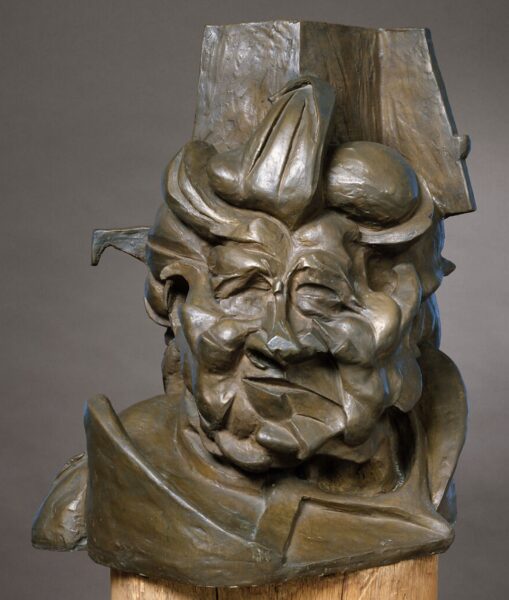
Boccioni’s genius is perhaps most famously immortalized in his sculptural work, particularly following his 1912 Technical Manifesto of Futurist Sculpture. His iconic bronze, Unique Forms of Continuity in Space (1913), perfectly embodies the Futurist ideal. Rather than depicting a static body, the sculpture captures a striding, aerodynamic figure that seems to be actively shaped and carved by the wind, speed, and surrounding atmosphere.
Like many Futurists, Boccioni glorified conflict and was a fervent supporter of Italy’s entry into World War I. He enlisted in an artillery regiment but, tragically, his brilliant career was cut short at age 33 when he died from injuries sustained in a fall from his horse during a cavalry training exercise.
Active in others filds : Sculpture, Art Theory (Author of key Futurist Manifestos), Printmaking, Military Service.