Fauvism
A comprehensive guide to the visual principles, history, and pioneers of this movement. Curated for researchers and students seeking a structured analysis of artistic styles.
Full General Specifications
Fauvism was the first of the major avant-garde movements of the 20th century. Its name originated from the French word les Fauves (“the wild beasts”), a term coined by critic Louis Vauxcelles after he saw the shocking, non-naturalistic colors at the 1905 Salon d’Automne.
For researchers and students, the defining technical achievement of Fauvism was the liberation of color. Before this movement, color was used to describe an object (a tree is green); Fauvist artists used color to describe an emotion or a formal sensation (a tree can be bright red if it feels right to the artist). While the movement was short-lived (lasting barely a decade), it laid the groundwork for Expressionism and all subsequent abstract art by proving that art did not need to mimic the physical world to be “true.”
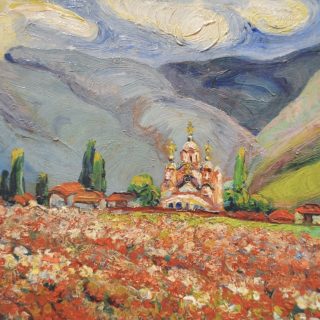
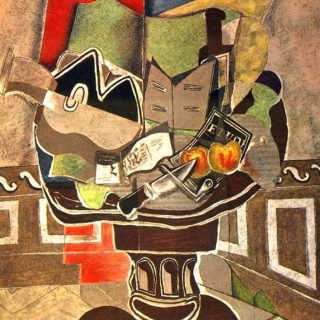
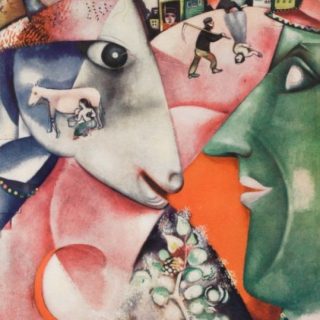
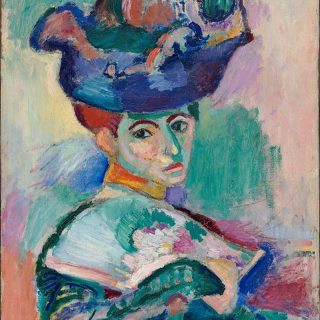
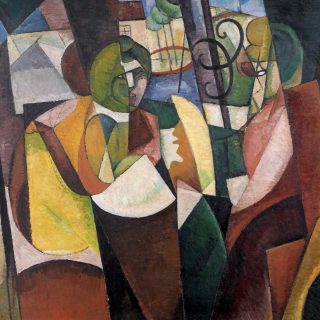
Related Random Fauvism Artwork
Classification
-
Category: Painting.
-
Era/Period: 1904–1910 (Early 20th Century).
-
Origin Location: Paris, France.
Visual & Technical Specs
-
Key Visual Characteristics: Intense, vibrant, and often “clashing” colors; simplified forms; spontaneous and visible brushwork; a lack of traditional perspective or three-dimensional modeling.
-
Color Palette: Pure, unmixed pigments. Heavily features Electric Blue, Cadmium Red, Bright Orange, and Emerald Green. Shadows are often rendered in deep purple or blue rather than black or grey.
-
Mediums & Tools: Oil on canvas with thick application (impasto), flat house-painting brushes for broad strokes, and tube paints (which allowed artists to work quickly and outdoors).
Pioneers & Key Works
-
Founders/Key Artists: Henri Matisse (the leader), André Derain, Maurice de Vlaminck, Raoul Dufy.
-
Masterpieces:
-
Woman with a Hat (Matisse, 1905) – The painting that sparked the “wild beast” comment.
-
Charing Cross Bridge (André Derain, 1906) – Featuring a red sky and blue water.
-
The Joy of Life (Le Bonheur de Vivre) (Matisse, 1905–06)
-
The River Seine at Chatou (Maurice de Vlaminck, 1906)
-
-
Influential Schools/Groups: Collioure group (where Matisse and Derain first experimented).
Philosophy & Context
-
The “Why”: The goal was to express the artist’s internal response to a subject rather than a literal transcription. Matisse famously said he wanted an art of “balance, purity, and serenity,” achieved through the raw power of color harmony.
-
Historical Context: It emerged during a time of great scientific and social change. Photography had already mastered realistic representation, so painters felt a “new freedom” to explore the psychological properties of light and color.
Modern Influence: Cinema, TV & CGI
-
2D, 3D, CGI, VFX: Fauvism is the ancestor of “Stylized Rendering” in animation. Whenever a film uses a non-naturalistic color grade to signal a mood (e.g., a neon-pink sky in a sci-fi film), it is using Fauvist logic.
-
Modern Legacy: Visible in the high-saturation aesthetics of films like La La Land or the psychedelic visuals of Spider-Man: Across the Spider-Verse.
Modern Influence: AI & Hybrid Media
-
Modern Legacy: AI models handle Fauvism well because it relies on high-contrast “feature edges” and distinct color zones. It is a popular style for converting mundane photographs into high-energy, artistic digital assets.
-
AI Prompting Keywords: Fauvism style, Henri Matisse aesthetic, André Derain colors, non-naturalistic color palette, bold impasto brushstrokes, high saturation, vivid pure pigments, expressive color, simplified shapes, flat pictorial space.


