




Art Style & Movement

SUB CATEGORIES
×

Pop Art

A comprehensive guide to the visual principles, history, and pioneers of this movement. Curated for researchers and students seeking a structured analysis of artistic styles.

Full General Specifcations for Pop Art

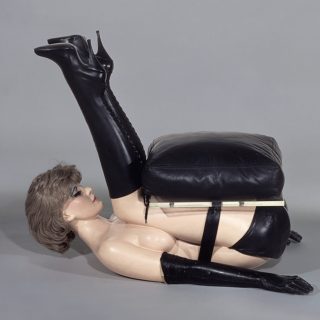
Pop Art was a revolutionary movement that blurred the line between “high art” and “low culture.” It emerged as a challenge to the elitism of Abstract Expressionism, choosing instead to find beauty and meaning in the mundane, the commercial, and the mass-produced.

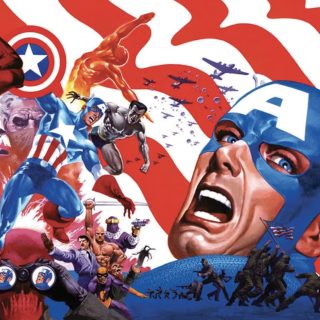
For researchers and students, Pop Art is defined by its use of appropriation—taking existing imagery from advertisements, comic books, and celebrity culture and placing them in an art gallery context. This was often achieved through mechanical reproduction techniques rather than traditional hand-painting. While it looks “fun” and vibrant, it often carries a satirical or ironic subtext regarding consumerism, fame, and the “American Dream.”

Related Random Pop Art Artwork

David Hockney

Classification

  • Category: Painting, Sculpture, Digital/AI Art, Fashion, Graphic Design.

  • Era/Period: Mid-1950s to 1970s (Late Modernism).

  • Origin Location: United Kingdom (Origins) and United States (Mainstream Explosion).

Visual & Technical Specs

  • Key Visual Characteristics: Bold outlines, vibrant “candy” colors, repetition of imagery (seriality), Ben-Day dots (comic book textures), collage, and the use of text/logos.

  • Color Palette: Dominated by highly saturated Primary Colors (Red, Blue, Yellow) and fluorescent “Neon” tones. Black is used heavily for structural outlines.

  • Mediums & Tools: Screen printing (Serigraphy), acrylic paint, collage, found objects, and early forms of digital manipulation (mass-production philosophy).

Pioneers & Key Works

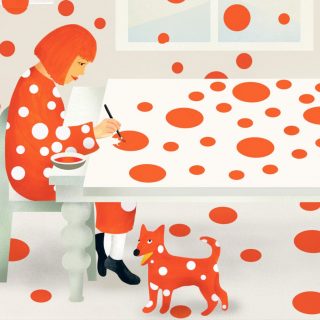
  • Founders/Key Artists: Andy Warhol, Roy Lichtenstein, Richard Hamilton, Keith Haring, Yayoi Kusama.

  • Masterpieces:

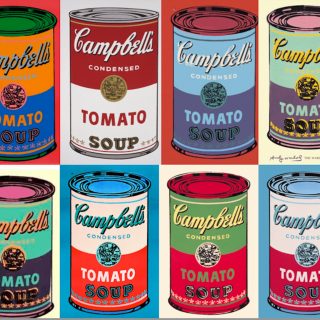
    1. Campbell’s Soup Cans (Andy Warhol, 1962)

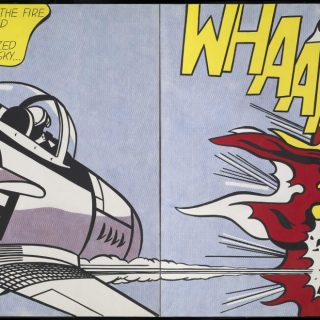
    2. Whaam! (Roy Lichtenstein, 1963)

    3. Just what is it that makes today’s homes so different, so appealing? (Richard Hamilton, 1956)

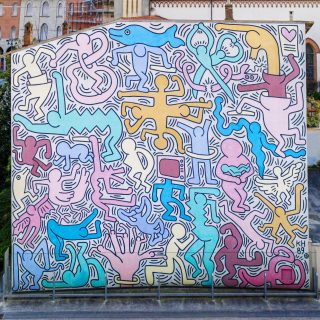
    4. Radiant Baby (Keith Haring, 1980s)

  • Influential Schools/Groups: The Independent Group (London), The Factory (Warhol’s Studio).

Philosophy & Context

  • The “Why”: To reflect the reality of the post-war world. Pop artists believed that art should be as accessible and “disposable” as a soda can. It sought to democratize art by making the everyday object the hero of the canvas.

  • Historical Context: Following WWII, the rise of mass media, television, and consumer products created a new visual landscape. Pop Art was the artist’s way of responding to the “booming” 1950s and 60s consumer culture.

Modern Influence: Cinema, TV & CGI

N/A

Modern Influence: AI & Hybrid Media

  • Modern Legacy: AI generators are particularly “native” to Pop Art because the style is based on patterns, repetition, and clear graphical boundaries—concepts AI excels at processing. It is frequently used for creating “Avatar” styles or social media marketing assets.

  • AI Prompting Keywords: Pop Art style, screen print, Andy Warhol style, Roy Lichtenstein dots, bold outlines, vibrant primary colors, repetitive imagery, halftone patterns, flat shading, 1960s advertising aesthetic.

Some Other Art Styles by Random Seed

Art Styles by random seed

Romanticism

Romanticism was an intellectual and artistic movement that emerged as a reaction against the scientific rationalism of the Enlightenment and the industrialization of the 18th century. It shifted the focus of art from objective “reason” to subjective emotion, the power of the individual, and the overwhelming awe of nature (The Sublime).

In visual arts, Romanticism is characterized by a move away from the rigid, “clean” lines of Neoclassicism toward a more painterly, expressive approach. Artists sought to capture the “uncontrollable”—stormy seas, misty mountains, ruins, and intense human psychological states (horror, passion, and insanity). It wasn’t about “romance” in the modern sense of dating; it was about the “romance” of the soul’s struggle against the infinite.

Rococo

Cubism represents the most radical break from traditional Western pictorial representation since the Renaissance. Developed primarily in Paris, it abandoned the single-viewpoint perspective that had dominated art for centuries. Instead, Cubist artists analyzed subjects from multiple angles, breaking them into geometric fragments and reassembling them within a shallow, ambiguous space.

For researchers and students, it is essential to distinguish between its two primary phases:

  • Analytic Cubism (1907–1912): Focused on breaking down forms into monochromatic, overlapping planes.

  • Synthetic Cubism (1912–1914): Introduced collage, vibrant colors, and simpler shapes, emphasizing the construction of new forms rather than the deconstruction of existing ones.

Surrealism

Surrealism is one of the most influential avant-garde movements of the 20th century, seeking to bridge the gap between dreams and reality. It emerged as a reaction to the “rationalism” that many artists believed had led to the horrors of World War I. Surrealism isn’t just a visual style; it is a means of exploring the unconscious mind.

Researchers and students should identify the two main stylistic branches:

  • Veristic (Representational) Surrealism: Uses academic, realistic techniques to depict “impossible” scenes with photographic precision (e.g., Dalí, Magritte). The shock comes from the illogical juxtaposition of recognizable objects.

  • Absolute (Automatic) Surrealism: Focuses on Automatism—allowing the hand to move randomly across the canvas without conscious control. This results in more abstract, biomorphic shapes (e.g., Joan Miró, André Masson).

Dada

Dada was not just an art style; it was a “protest” and a “state of mind.” Emerging as a direct response to the horrors of World War I, Dadaists argued that if a “rational” society could produce such irrational slaughter, then reason and logic themselves were invalid. Consequently, Dada sought to destroy traditional aesthetics through anti-art.

For researchers and art centers, Dada is critical because it introduced the concept of the “Readymade”—taking ordinary, manufactured objects and declaring them art simply by placing them in a gallery. It broke the “sacred” bond between the artist’s hand and the final work. Dada is the ancestor of Surrealism, Pop Art, and Conceptual Art. It utilized nonsense, irony, and “chance” as its primary creative tools, often using “cut-up” techniques in both poetry and visual collage.

Architectural

Architectural movements represent the evolution of human civilization through the lens of Form, Function, and Material. Unlike isolated art movements, architecture is bound by the laws of physics and the socio-economic needs of the time. A “Movement” in architecture is defined by a shared vocabulary of structural elements (how it stands up) and aesthetic ornamentation (how it looks).

For the Cgitems database, architectural movements are analyzed through three primary lenses:

  • Structural Innovation: The transition from Post-and-Lintel (Ancient) to Arches/Vaults (Medieval) to Steel Frames (Modern) and finally to Computational/Parametric design.

  • Spatial Philosophy: How a building treats the person inside—from the intimidating “divine scale” of the Gothic era to the “human-centric” ergonomics of Modernism.

  • The Facade & Envelope: The “skin” of the building, which reflects the artistic trends of the era, such as the intricate carvings of the Baroque or the “Glass Curtain Walls” of the International Style.

Cubism

Cubism is arguably the most influential art movement of the 20th century, marking a definitive break from the traditional Renaissance window-on-the-world perspective. At its core, Cubism is an analytical approach to three-dimensional reality, where objects are analyzed, broken up, and reassembled in an abstracted form.

For researchers and students, it is essential to distinguish between its two primary phases:

  • Analytic Cubism (1907–1912): Characterized by a fragmented, “shattered” appearance with a monochromatic color palette. The goal was to represent all viewpoints of an object simultaneously.

  • Synthetic Cubism (1912–1914): Introduced collage elements (newspaper, sand, cloth) and brighter colors, focusing on building up new forms from diverse materials rather than breaking them down

Need Help?

Questions ! Comments ? You Tell Us We Listen .

Feel free to contact us

Add Your Heading Text Here

Login