



Art Style & Movement
Tonalism
A comprehensive guide to the visual principles, history, and pioneers of this movement. Curated for researchers and students seeking a structured analysis of artistic styles.
Full General Specifcations for Tonalism
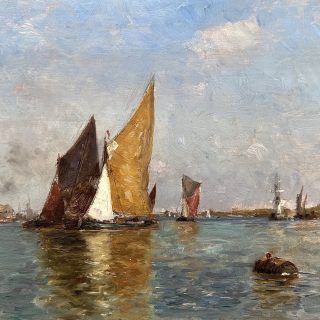
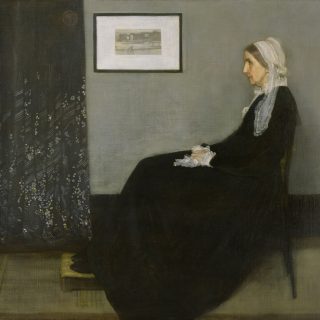
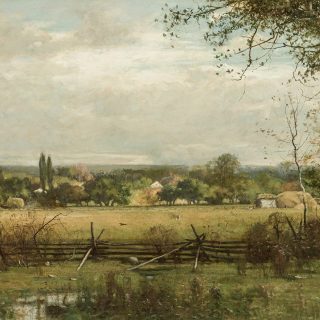
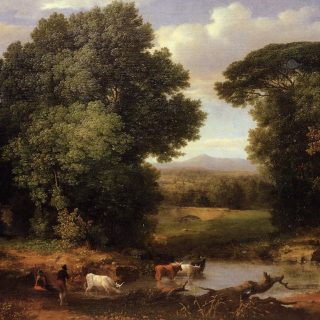
Tonalism was an American artistic style that emerged in the late 19th century, characterized by soft, diffused light and a limited range of monochromatic or “tonal” colors. Unlike the bright, flickering light of French Impressionism, Tonalism focused on the mood and atmosphere of a landscape, often depicting it during “mystical” times of day—dawn, twilight, or under moonlight and mist.
For researchers and students, it is important to note that Tonalism was less about the physical details of a place and more about the emotional response it evoked. The paintings often have a “veiled” or “dreamlike” quality, achieved through multiple layers of thin glazes that make the surface appear to glow from within. It is considered a bridge between 19th-century Realism and 20th-century Abstraction.
Related Random Tonalism Artwork
Classification
-
Category: Painting (Landscape & Nocturnes).
-
Era/Period: Late 19th to early 20th century (c. 1880–1915).
-
Origin Location: United States (influenced by the French Barbizon School).
Visual & Technical Specs
-
Key Visual Characteristics: Minimalist compositions, “soft focus” or blurred edges, lack of sharp detail, and a dominant single-color tone that unifies the entire canvas.
-
Color Palette: Muted, neutral, and monochromatic. Predominant colors include Greys, Olive Greens, Deep Blues, Burnt Umbers, and Hazy Silvers. Vibrant or primary colors are strictly avoided.
-
Mediums & Tools: Oil on canvas with heavy use of Glazing (thin, transparent layers of paint) and “Scumbling” (applying a thin layer of opaque, light-colored paint over a darker area).
Pioneers & Key Works
-
Founders/Key Artists: George Inness, James Abbott McNeill Whistler, Dwight William Tryon, Thomas Wilmer Dewing.
-
Masterpieces:
-
Nocturne: Blue and Silver – Chelsea (Whistler, 1871)
-
The Home of the Heron (George Inness, 1893)
-
Sunrise (George Inness, 1887)
-
The Hermit (John Singer Sargent, 1908 – Tonalist influence)
-
-
Influential Schools/Groups: The Barbizon School (influence), The Lyrical School.
Philosophy & Context
-
The “Why”: To evoke a spiritual or meditative state. Tonalists believed that by stripping away distracting details and focusing on a single “tone,” they could capture the inner life of nature and the “music” of a landscape.
-
Historical Context: It was a quiet rebellion against the loud, chaotic Industrial Revolution. While the world was becoming faster and noisier, Tonalism offered a visual “silence”—a return to nature’s mystery and solitude.
Modern Influence: Cinema, TV & CGI
-
2D, 3D, CGI, VFX: Tonalism is the foundation for “Low-Key Lighting” in digital environments. It heavily influences “Atmospheric Fog” and “Volumetric Lighting” settings in game engines like Unreal Engine and Unity.
-
Modern Legacy: It is the primary visual reference for “Nordic Noir” cinematography and moody, slow-burn psychological films where the environment reflects the character’s internal state.
-
Modern Influence: AI & Hybrid Media
-
Modern Legacy: AI excels at Tonalism because the style relies on gradients and soft transitions—areas where diffusion models naturally perform well. It is a favorite style for creating high-end, “calm” architectural visualizations and concept art for “dark academia.”
-
AI Prompting Keywords: Tonalism style, atmospheric perspective, muted color palette, soft focus, misty morning, moonlight glow, George Inness style, monochromatic landscape, diffused light, hazy atmosphere, low contrast, meditative mood.
Some Other Art Styles by Random Seed
Art Styles by random seed
Romanticism
Romanticism was an intellectual and artistic movement that emerged as a reaction against the scientific rationalism of the Enlightenment and the industrialization of the 18th century. It shifted the focus of art from objective “reason” to subjective emotion, the power of the individual, and the overwhelming awe of nature (The Sublime).
In visual arts, Romanticism is characterized by a move away from the rigid, “clean” lines of Neoclassicism toward a more painterly, expressive approach. Artists sought to capture the “uncontrollable”—stormy seas, misty mountains, ruins, and intense human psychological states (horror, passion, and insanity). It wasn’t about “romance” in the modern sense of dating; it was about the “romance” of the soul’s struggle against the infinite.
Sci-fi - Futurist
Science Fiction art is a visionary genre that depicts imagined technological advancements, space exploration, and futuristic civilizations. It is a “literature of ideas” rendered visually. Unlike pure fantasy, Sci-Fi art is grounded in extrapolation—taking current scientific trends and pushing them to their logical (or illogical) extremes.
The style is defined by its ability to balance the Technological Sublime (massive, awe-inspiring machines) with meticulous mechanical detail. It functions as a bridge between industrial design and fine art. Key sub-movements include:
-
Golden Age (1930s-50s): Optimistic, sleek, “Aero-styled” rockets and bright, primary-colored spacesuits.
-
New Wave/Cyberpunk (1970s-80s): Gritty, “used future” aesthetics, neon-noir lighting, and the fusion of biology with technology.
-
Hard Sci-Fi: Prioritizes physical accuracy, structural engineering, and realistic orbital mechanics in its visuals.
Surrealism
Surrealism is one of the most influential avant-garde movements of the 20th century, seeking to bridge the gap between dreams and reality. It emerged as a reaction to the “rationalism” that many artists believed had led to the horrors of World War I. Surrealism isn’t just a visual style; it is a means of exploring the unconscious mind.
Researchers and students should identify the two main stylistic branches:
-
Veristic (Representational) Surrealism: Uses academic, realistic techniques to depict “impossible” scenes with photographic precision (e.g., Dalí, Magritte). The shock comes from the illogical juxtaposition of recognizable objects.
-
Absolute (Automatic) Surrealism: Focuses on Automatism—allowing the hand to move randomly across the canvas without conscious control. This results in more abstract, biomorphic shapes (e.g., Joan Miró, André Masson).
Muralism
Muralism is a monumental art form characterized by large-scale paintings applied directly to walls, ceilings, or other permanent surfaces. While mural painting dates back to antiquity, the modern movement—Mexican Muralism—transformed it into a powerful tool for social and political transformation. Unlike canvas paintings housed in private galleries, Muralism is inherently public art, designed to be accessible to the masses regardless of their education or economic status.
For students and researchers, the technical “Long Form” of Muralism involves a complex integration of architecture and narrative. The artist must consider the viewer’s physical movement through a space, often using polyangular perspective (pioneered by Siqueiros) so that the image remains coherent from multiple walking angles. It frequently blends indigenous motifs with industrial imagery, symbolizing a bridge between a nation’s past and its technological future.
Fauvism
Fauvism was the first of the major avant-garde movements of the 20th century. Its name originated from the French word les Fauves (“the wild beasts”), a term coined by critic Louis Vauxcelles after he saw the shocking, non-naturalistic colors at the 1905 Salon d’Automne.
For researchers and students, the defining technical achievement of Fauvism was the liberation of color. Before this movement, color was used to describe an object (a tree is green); Fauvist artists used color to describe an emotion or a formal sensation (a tree can be bright red if it feels right to the artist). While the movement was short-lived (lasting barely a decade), it laid the groundwork for Expressionism and all subsequent abstract art by proving that art did not need to mimic the physical world to be “true.”
Comic
Comic art is a sophisticated visual language that combines sequential imagery with textual elements (word balloons, onomatopoeia, and captions) to deliver a narrative. Unlike a single painting, comic art relies on the “gutter”—the space between panels—where the reader’s imagination bridges the gap between actions, a concept known as closure.
Technically, it is defined by its use of graphic shorthand. Because comics were historically printed on cheap newsprint, artists developed a style using high-contrast black inks and limited color palettes (like the Ben-Day dots process) to ensure clarity. Modern comic art has evolved into various sub-genres:
-
The Silver/Golden Age Style: Characterized by heroic proportions, bold primary colors, and heavy “Kirby Krackle” energy signatures.
-
Noir/Dark Age: Focused on heavy chiaroscuro (extreme light and shadow) and gritty realism.
-
Clear Line (Ligne Claire): Popularized by Franco-Belgian creators, emphasizing strong, continuous outlines and vivid, flat colors without hatching.


