
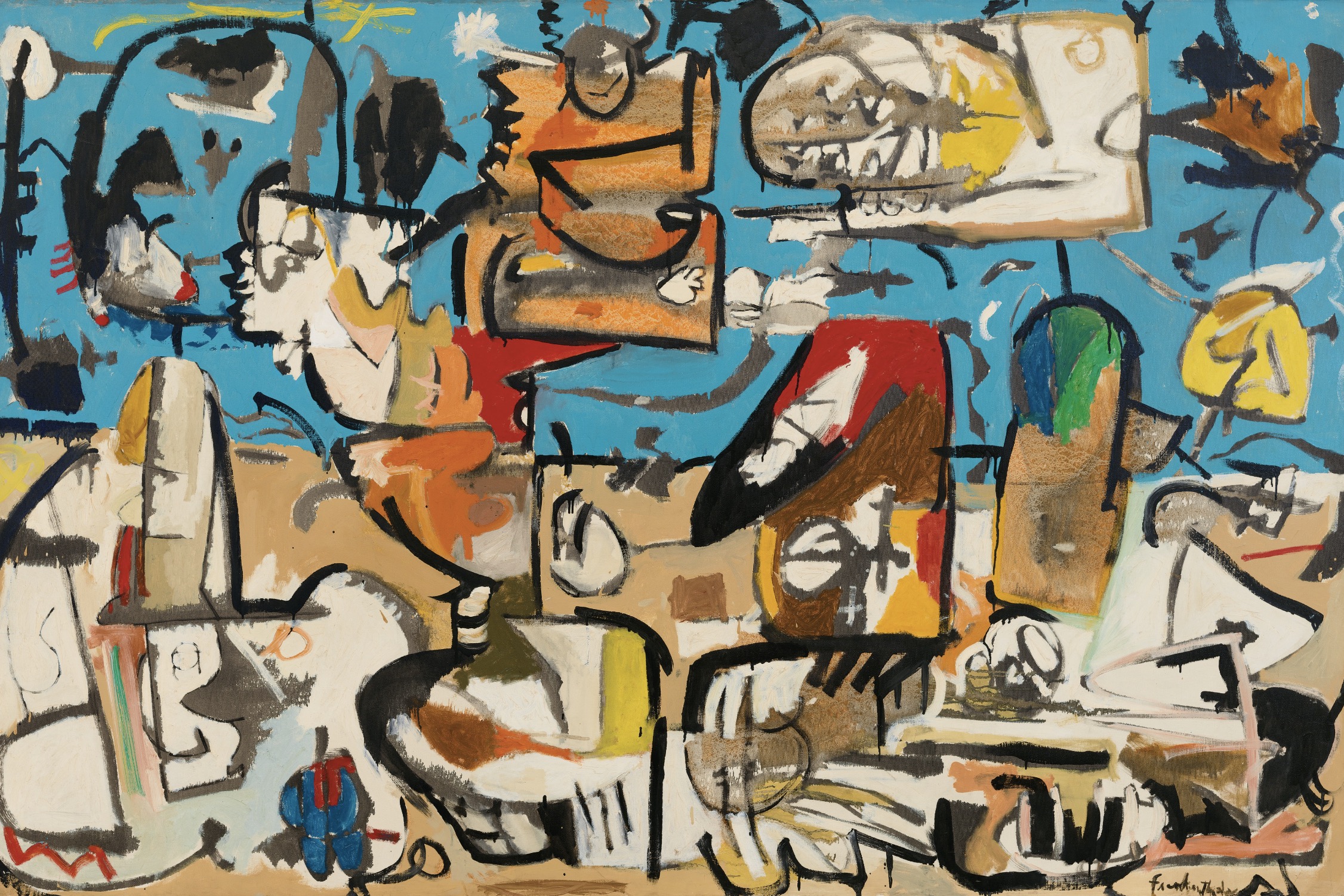




Helen Frankenthaler (1928–2011) was a towering figure in postwar American painting, credited with bridging the gap between the aggressive energy of Abstract Expressionism and the serene expansiveness of Color Field painting.
The youngest daughter of a New York Supreme Court justice, Frankenthaler was educated at progressive schools where she studied under masters like Rufino Tamayo. Her career was forever changed in the early 1950s after she visited Jackson Pollock’s studio and witnessed his “drip” technique. However, rather than mimicking Pollock’s thick, textured layers, Frankenthaler sought a more ethereal, fluid aesthetic.
In 1952, at the age of 23, she created her breakthrough masterpiece, Mountains and Sea. To achieve its unique look, she invented the “Soak-Stain” technique: she thinned oil paint with turpentine or kerosene to the consistency of watercolor and poured it onto raw, unprimed canvas spread on the floor. The paint soaked directly into the fibers, merging color and surface into a single, unified plane. This innovation allowed her to create “luminous color washes” that appeared to float and breathe, a departure from the heavy “impasto” of her contemporaries.
Her work was the catalyst for the Color Field movement, deeply influencing artists like Morris Louis and Kenneth Noland. While her paintings were abstract, they often maintained a “lyrical” connection to nature, suggesting landscapes, horizons, and atmosphere without explicitly depicting them. Over six decades, she evolved her style, moving from oils to acrylics in the 1960s—which allowed for sharper edges and more saturated tones—and eventually becoming a pioneer in the “print renaissance,” particularly with her revolutionary woodcuts.
Frankenthaler received the National Medal of Arts in 2001 and remains one of the most celebrated women in art history for her role in redefining the possibilities of the canvas.
Active in others filds : Printmaking (Woodcuts/Lithography), Sculpture, Ceramics, Tapestry, Set and Costume Design (for the Royal Ballet).