


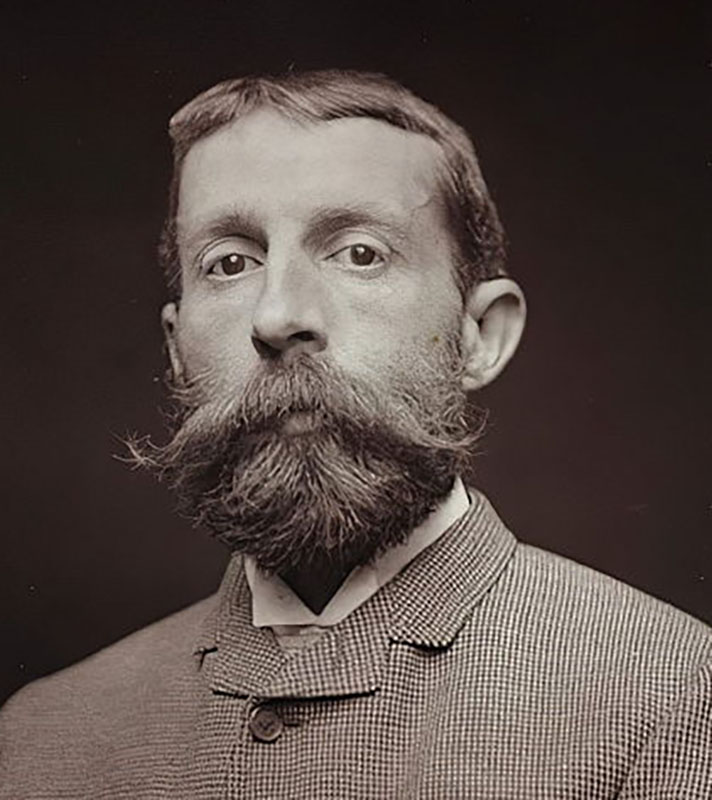



Edwin Lord Weeks (Parents: Stephen Weeks and Mary Lord Weeks, prominent Boston merchants) was one of the most celebrated and internationally renowned American Orientalist painters of the late 19th century. Renowned for his remarkably detailed and vivid depictions of North Africa, the Middle East, and particularly India, he mastered the interplay of intense sunlight, intricate architectural textures, and vibrant local costumes.
Born into a wealthy merchant family in Boston, his parents’ prosperity allowed him to pursue both travel and artistic studies from a young age. Weeks was an avid traveler before he received formal European training; by 1870, he had already journeyed to Egypt, Syria, and Palestine. In 1874, he moved to Paris to study painting, entering the atelier of Léon Bonnat, who instilled in him a strict commitment to realism and a rich color palette, while also drawing encouragement from Jean-Léon Gérôme.
Weeks chose to spend the majority of his adult life based in Paris, using it as a starting point for extensive expeditions. He spent years capturing the street scenes of Morocco before undertaking three massive, epic journeys to India between 1882 and 1893. During his 1892 expedition, he traveled overland across the Black Sea and through Persia to India alongside journalist Theodore Child. Armed with sketchbooks, oil canvases, and a camera, Weeks captured the sprawling grandeur of the Mughal architecture, open-air bazaars, and royal elephant processions.
His style was heavily defined by what art historians call the “glare aesthetic”—an exceptional ability to paint the blinding, searing quality of direct sunlight striking marble, white stone, and dusty landscapes. Weeks achieved immense success at the annual Paris Salons, where his monumental Indian scenes became highly coveted by elite French and American collectors. He was also an accomplished author, publishing detailed travelogues illustrated with his own drawings. Weeks fell ill and passed away in his Paris studio in 1903 at the age of 54, suspected to have succumbed to an illness or fever initially contracted during his eastern travels.
Active in others filds :
Travel Writing & Literature (Author of From the Black Sea Through Persia and India), Travel Photography (Using early cameras to record field reference material).
Notable Collaborations :
Throughout his career, Weeks collaborated closely with the writer and journalist Theodore Child, traveling overland together on a dangerous, grueling assignment sponsored by Harper’s Magazine from the Black Sea, through Persia, to India. Weeks provided the intricate visual illustrations to supplement Child’s written dispatches. During his academic years in Paris, he also maintained deep artistic ties with his instructors, the celebrated masters Léon Bonnat and Jean-Léon Gérôme.
Edwin Lord Weeks Legacy :
Edwin Lord Weeks left behind an unparalleled visual record of 19th-century non-Western cultures, standing alongside Frederick Arthur Bridgman as the pinnacle of the American Orientalist movement. His legacy lies in his artistic empathy and optical precision; where contemporary travelers often observed only exoticism or poverty, Weeks brought an academic dignity to his subjects, focusing entirely on the enchanting glories of light, shadow, and architectural detail. Today, his masterpieces are considered valuable historical and architectural records, fetching millions at international auctions and remaining prized centerpieces in institutions such as the Metropolitan Museum of Art and the Boston Museum of Fine Arts.
Selected Notable Works :
A Blacksmith’s Shop in Tangiers (1876), The Moroccan Camel Driver (1878), The Last Voyage: Souvenir of the Ganges (1884), The Rajah of Jodhpur (1888), The Hour of Prayer at the Pearl Mosque, Agra (1889), Arrival of a Caravan outside the Walls of Marrakech (1890), Along the Ghats, Mathura (1892), The Grand Mogul and his Court Returning from the Great Mosque at Delhi (1893), Palace and Lake at Sarkhej-Ahmedabad (1895), Entering the Mosque (1898)
Honors :
Honorable Mention at the Paris Salon (1884), Gold Medal at the Paris Salon (1889), Grand Diploma of Honor at the Berlin International Exposition (1891), Gold Medal at the Philadelphia Art Club (1891), Knight of the French Legion of Honor (1896), Officer of the Order of St. Michael (Bavaria)



