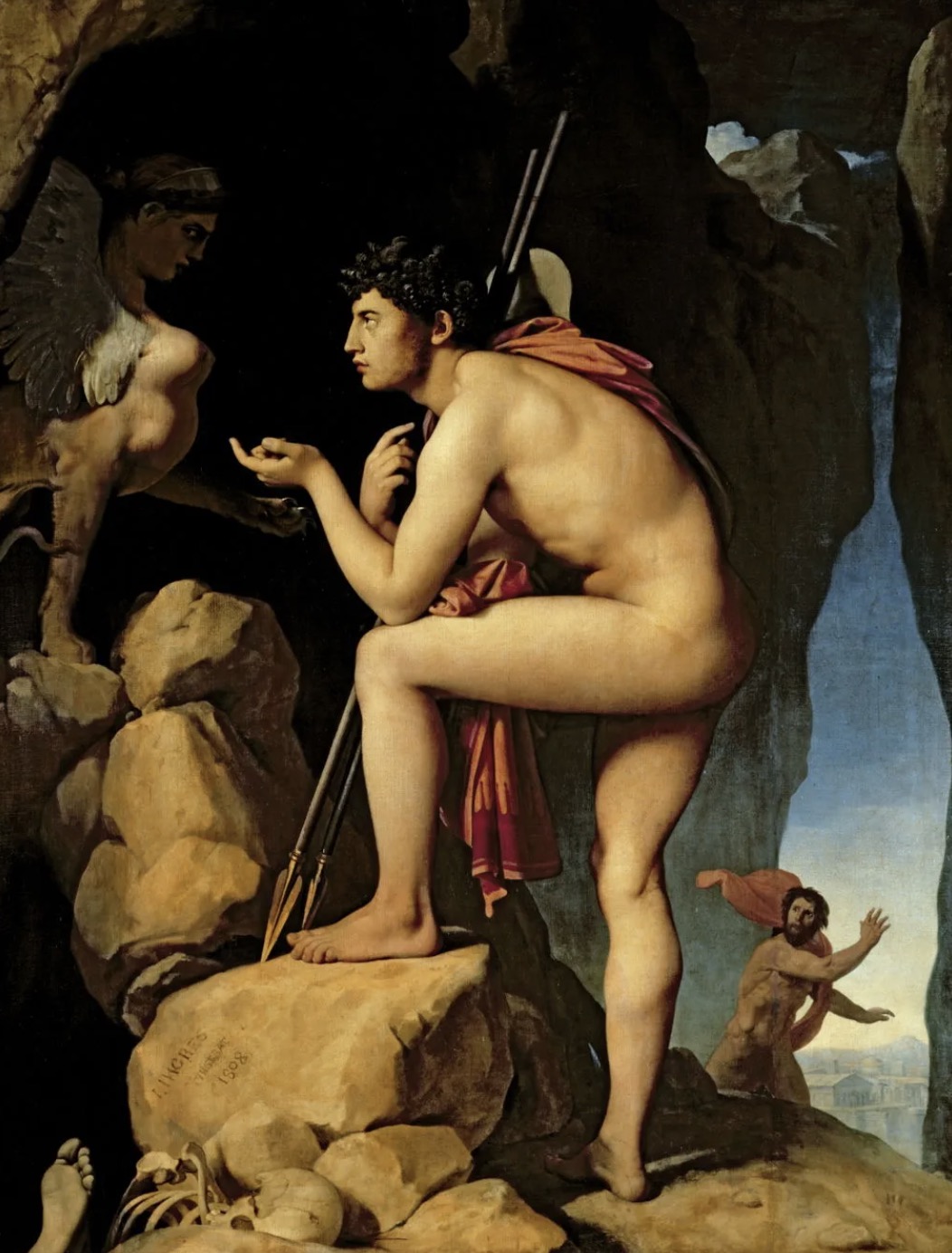






Jean-Auguste-Dominique Ingres ( 29 August 1780 – 14 January 1867) was a French Neoclassical painter. Ingres was profoundly influenced by past artistic traditions and aspired to become the guardian of academic orthodoxy against the ascendant Romantic style. Although he considered himself a painter of history in the tradition of Nicolas Poussin and Jacques-Louis David, it is his portraits, both painted and drawn, that are recognized as his greatest legacy. His expressive distortions of form and space made him an important precursor of modern art, influencing Picasso, Matisse and other modernists.
Born into a modest family in Montauban, he travelled to Paris to study in the studio of David. In 1802 he made his Salon debut, and won the Prix de Rome for his painting The Ambassadors of Agamemnon in the tent of Achilles. By the time he departed in 1806 for his residency in Rome, his style—revealing his close study of Italian and Flemish Renaissance masters—was fully developed, and would change little for the rest of his life. While working in Rome and subsequently Florence from 1806 to 1824, he regularly sent paintings to the Paris Salon, where they were faulted by critics who found his style bizarre and archaic. He received few commissions during this period for the history paintings he aspired to paint, but was able to support himself and his wife as a portrait painter and draughtsman.
He was finally recognized at the Salon in 1824, when his Raphaelesque painting, The Vow of Louis XIII, was met with acclaim, and Ingres was acknowledged as the leader of the Neoclassical school in France. Although the income from commissions for history paintings allowed him to paint fewer portraits, his Portrait of Monsieur Bertin marked his next popular success in 1833. The following year, his indignation at the harsh criticism of his ambitious composition The Martyrdom of Saint Symphorian caused him to return to Italy, where he assumed directorship of the French Academy in Rome in 1835. He returned to Paris for good in 1841. In his later years he painted new versions of many of his earlier compositions, a series of designs for stained glass windows, several important portraits of women, and The Turkish Bath, the last of his several Orientalist paintings of the female nude, which he finished at the age of 83.