A comprehensive guide to the visual principles, history, and pioneers of this movement. Curated for researchers and students seeking a structured analysis of artistic styles.
Full General Specifcations for Realism
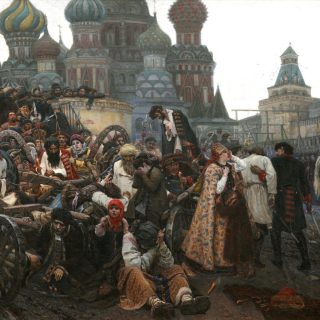
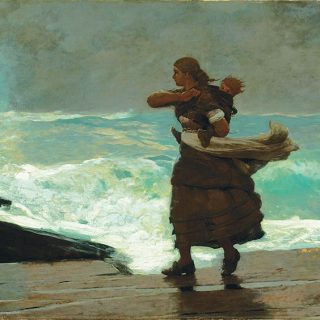
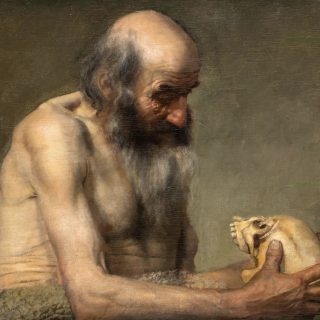
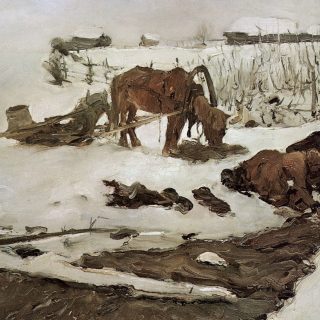
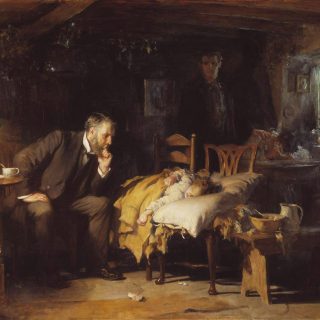
Realism was a pivotal 19th-century movement that acted as a “truth-telling” force in art. It emerged as a direct rejection of Romanticism (which exaggerated emotion) and Neoclassicism (which idealized history). Realism insisted on depicting the world exactly as it was—warts and all—focusing on the mundane, the gritty, and the everyday lives of the working class.
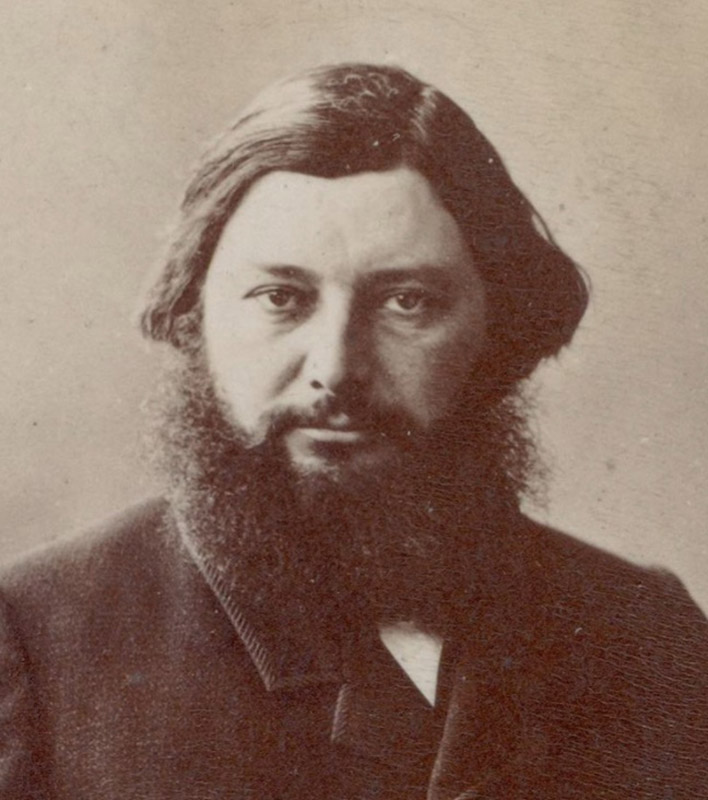
For researchers and students, it is crucial to distinguish between Artistic Realism (the movement) and Photorealism (the technical ability to mimic a photo). Realism wasn’t just about “looking real”; it was about “being honest.” Realist painters refused to paint angels or Greek gods because, as Gustave Courbet famously said, “I have never seen an angel. Show me an angel, and I will paint one.” This movement laid the essential groundwork for Impressionism and all subsequent modern art by breaking the rules of what was considered “worthy” of being painted.
Origin Location:France (spreading throughout Europe and the USA).
Visual & Technical Specs
Key Visual Characteristics: Objective depiction of contemporary life, lack of idealization, emphasis on physical labor, textural honesty (dirt, worn fabric, aged skin), and naturalistic light.
Color Palette: Grounded and earthy. Predominant use of raw umber, sienna, muted ochre, slate grey, and deep forest greens. It avoids the “synthetic” or overly vibrant colors of later movements.
Mediums & Tools: Oil on canvas with a focus on “heavy” application to represent the weight of the subject matter. Pallet knives were often used to create rugged textures.
The “Why”: The goal was to democratize art. Realists believed that the life of a peasant was as important as the life of a general. They wanted to strip away the “fake” drama of the past and confront the viewer with the social realities of their own time.
Historical Context: Developed during the Industrial Revolution and the Rise of Socialism. As the working class grew and faced harsh conditions, artists used their brushes as a form of social reportage.
Modern Influence: Cinema, TV & CGI
N/A
Modern Influence: AI & Hybrid Media
Modern Legacy: In AI prompting, “Realism” is used to counteract the overly “glossy” or “digital” look that AI often defaults to. It forces the model to include skin pores, fabric fraying, and natural lighting inconsistencies.
AI Prompting Keywords:Realism style, 19th-century realism, oil on canvas, earthy tones, muted colors, gritty texture, everyday life, natural lighting, unidealized, highly detailed skin texture, raw umber palette, Gustave Courbet style.
Some Other Art Styles
Art Styles by random seed
Orientalism
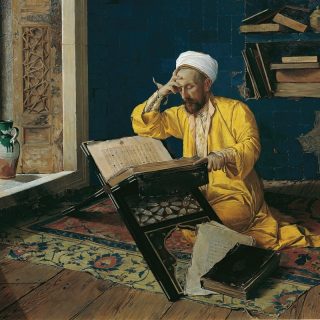
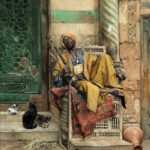
Orientalism in the visual arts refers to a specific movement in the 19th century where Western painters—primarily from France, Britain, and Germany—depicted the landscapes, people, and cultures of the Near East, Middle East, and North Africa. It is characterized by an Academic Realism so precise it often feels photographic, though the subjects were frequently romanticized or staged.
For researchers and students, it is vital to understand that Orientalism functioned as both an artistic style and a cultural lens. The movement is divided into two main artistic approaches:
The Ethnographic/Documentary Style: Artists who traveled extensively (like David Roberts) and sought to capture the architecture and ruins of Egypt and the Levant with archaeological accuracy.
The Romantic/Imaginary Style: Artists (like Jean-Léon Gérôme) who created highly detailed, “hyper-real” scenes of harems, bazaars, and desert life, often blending various cultures into a singular, exotic “Orient” that appealed to European fantasies.
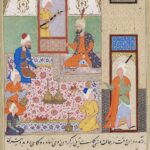
Miniature painting is a highly disciplined, small-scale art form characterized by extreme precision, vibrant mineral pigments, and a rejection of Western three-dimensional perspective. While each region has its own identity, they share a “flat” or isometric perspective, where the importance of a subject is dictated by its placement or color rather than its distance from the viewer.
Persian (Iranian) Miniature: Known for the “Herat” and “Safavid” schools. It features lyrical compositions, intricate “Tazhib” (illumination), and a focus on epic poetry (Shahnameh) and mysticism.
Indian (Mughal/Rajput) Miniature: A fusion of Persian technique and Indian flora/fauna. It introduced more naturalism, portraiture, and the “Ragmala” (musical modes) paintings.
East Asian (China/Japan) Influence: While often appearing as scrolls, the “miniature” element exists in Album Leaves and Fan Paintings. They emphasize calligraphic line work, the “spirit resonance” of brushstrokes, and the philosophical use of “negative space” (Ma).
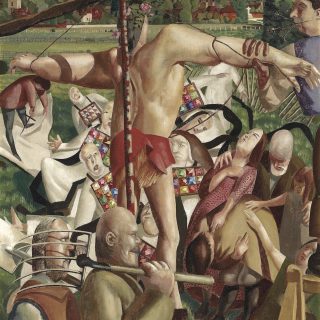
Gothic art was a medieval movement that revolutionized European aesthetics, transitioning from the heavy, dark, and earthbound Romanesque style to a form defined by height, light, and verticality. While often associated with “darkness” in modern pop culture, the original Gothic movement was obsessed with the divine quality of light (Lux Nova).
In architecture, the style solved the “weight problem” of stone buildings. By using pointed arches and ribbed vaults, builders could channel weight downward rather than outward, allowing walls to be thinner and replaced with massive stained-glass windows. In visual arts, Gothic style marked a move toward greater realism; figures became less stiff and more emotional compared to Byzantine or Romanesque predecessors, showing naturalistic drapery and human expressions.
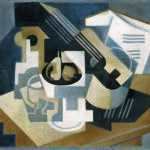
Cubism is arguably the most influential art movement of the 20th century, marking a definitive break from the traditional Renaissance window-on-the-world perspective. At its core, Cubism is an analytical approach to three-dimensional reality, where objects are analyzed, broken up, and reassembled in an abstracted form.
For researchers and students, it is essential to distinguish between its two primary phases:
Analytic Cubism (1907–1912): Characterized by a fragmented, “shattered” appearance with a monochromatic color palette. The goal was to represent all viewpoints of an object simultaneously.
Synthetic Cubism (1912–1914): Introduced collage elements (newspaper, sand, cloth) and brighter colors, focusing on building up new forms from diverse materials rather than breaking them down
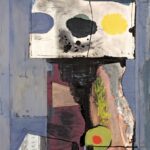
Abstract art represents a pivotal departure from “mimesis” (the imitation of visible reality). Instead of depicting recognizable objects from the physical world, it uses a formal language of shape, form, color, and line to create a composition that may exist with a degree of independence from visual references in the world.
For researchers and art centers, it is categorized into two main movements:
Non-Objective / Non-Representational: Work that does not take anything from the real world as a starting point. It is pure form and color (e.g., Mondrian).
Abstracted Reality: Work that begins with a real-world subject (like a figure or landscape) and simplifies or distorts it until the original source is nearly unrecognizable (e.g., early Kandinsky).
The movement evolved through various sub-genres, including Geometric Abstraction (logical and calculated) and Lyrical Abstraction (emotional and gestural). It challenged the viewer to “feel” the art rather than “identify” it.
Fantasy art is a broad and enduring genre of speculative fiction that depicts magical, supernatural, or mythological themes. Unlike “Realism,” which seeks to document the world as it is, Fantasy art uses the “Secondary World” concept—creating entirely new ecosystems, architectures, and biomes that operate under their own internal logic.
Historically, it evolved from folk tales and religious iconography into a massive commercial industry. It is characterized by Heroic Realism, where the human (or humanoid) figure is often idealized and placed in extreme, awe-inspiring environments. For students and researchers, the genre is often subdivided into:
High Fantasy: Epic scales, medieval-inspired aesthetics, and clear struggles between light and dark.
Dark Fantasy: Incorporates elements of horror, decay, and morally ambiguous “anti-heroes.”
Urban Fantasy: Merges magical elements with modern, gritty cityscapes.