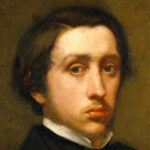



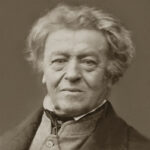
Ferdinand Victor Eugène Delacroix (Legal Father: Charles-François Delacroix, though widely believed to be the biological son of French statesman Charles Maurice de Talleyrand-Périgord; Mother: Victoire Oeben)
Ferdinand Victor Eugène Delacroix (1798–1863) was profoundly influential as the leader of the French Romantic school of painting. Rejecting the precise drawing and cool detachment of Neoclassicism championed by his rival, Jean-Auguste-Dominique Ingres, Delacroix prioritized passionate emotion, dramatic lighting, and the expressive power of color.
Born into a family with high political and artistic connections (his mother was a descendant of celebrated royal cabinetmakers), Delacroix was orphaned by age 16. He studied under Pierre-Narcisse Guérin alongside Théodore Géricault, whose dynamic approach deeply impacted him. Delacroix’s debut at the Paris Salon, The Barque of Dante (1822), immediately marked him as a rising star of the modern, Romantic style.
His early career was defined by massive, controversial canvases depicting historical suffering and raw emotion. Works like The Massacre at Chios (1824) and The Death of Sardanapalus (1827) shocked critics with their vivid violence and swirling compositions. In 1830, he painted his most iconic masterpiece, Liberty Leading the People, a monumental tribute to the July Revolution. The painting’s combination of stark realism and powerful allegory cemented his legacy as the defining artist of his era.
In 1832, Delacroix traveled to Spain and North Africa (Morocco and Algeria) as part of a diplomatic mission. This journey fundamentally transformed his art. Captivated by the intense light, vibrant fabrics, and the “living antiquity” of the people, he filled countless sketchbooks that would serve as a wellspring of inspiration for the rest of his life. Works like The Women of Algiers (1834) introduced Orientalism to his repertoire and featured a much brighter, looser palette.
In his later years, Delacroix focused heavily on monumental architectural commissions, painting breathtaking murals for the Palais Bourbon, the Palais du Luxembourg, and the Church of Saint-Sulpice in Paris. His energetic brushwork, study of the optical effects of color, and deeply personal journals made him an idol for the next generation of painters, directly paving the way for the Impressionists and Post-Impressionists.
Active in others filds : Lithography (Illustrations for Shakespeare and Goethe), Mural Painting, Writing (His Journal remains one of the most important artist diaries in history).