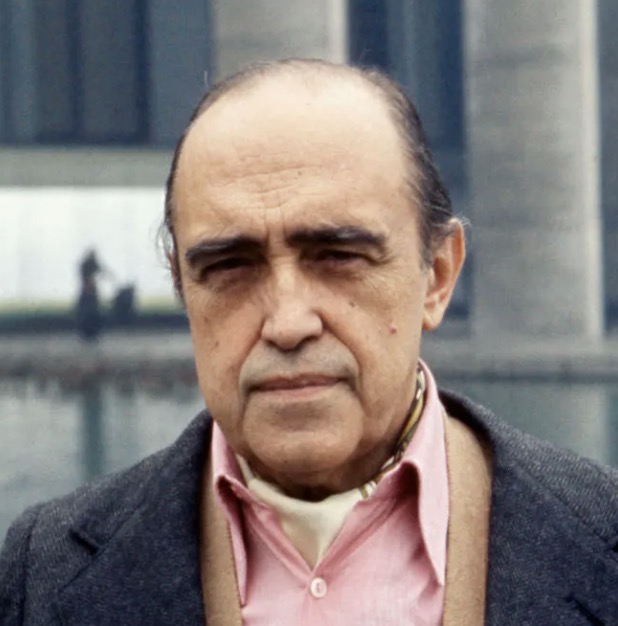

Oscar Ribeiro de Almeida Niemeyer Soares Filho (Parents: Oscar Niemeyer Soares and Delfina Ribeiro de Almeida; Spouses: Annita Baldo, Vera Lúcia Cabreira; Daughter: Anna Maria Niemeyer)
Oscar Niemeyer (1907–2012) was a visionary Brazilian architect who reshaped the landscape of 20th-century modernism. While the International Style of his era was heavily dominated by the rigid, functionalist right angles championed by figures like Walter Gropius and Mies van der Rohe, Niemeyer famously rejected the “hard, inflexible” straight line. Instead, he pioneered an architecture defined by sweeping, sensual curves inspired by the natural landscapes of his homeland.
After graduating from the National School of Fine Arts in Rio de Janeiro, Niemeyer began working with the pioneering Brazilian modernist Lúcio Costa. In 1936, the two collaborated with the legendary Swiss-French architect Le Corbusier on the Ministry of Education and Health building in Rio, a project that firmly placed Brazilian architecture on the global map. Niemeyer’s first major solo triumph came in 1940 with the Pampulha complex in Belo Horizonte, where he first fully explored the expressive, sculptural potential of reinforced concrete.
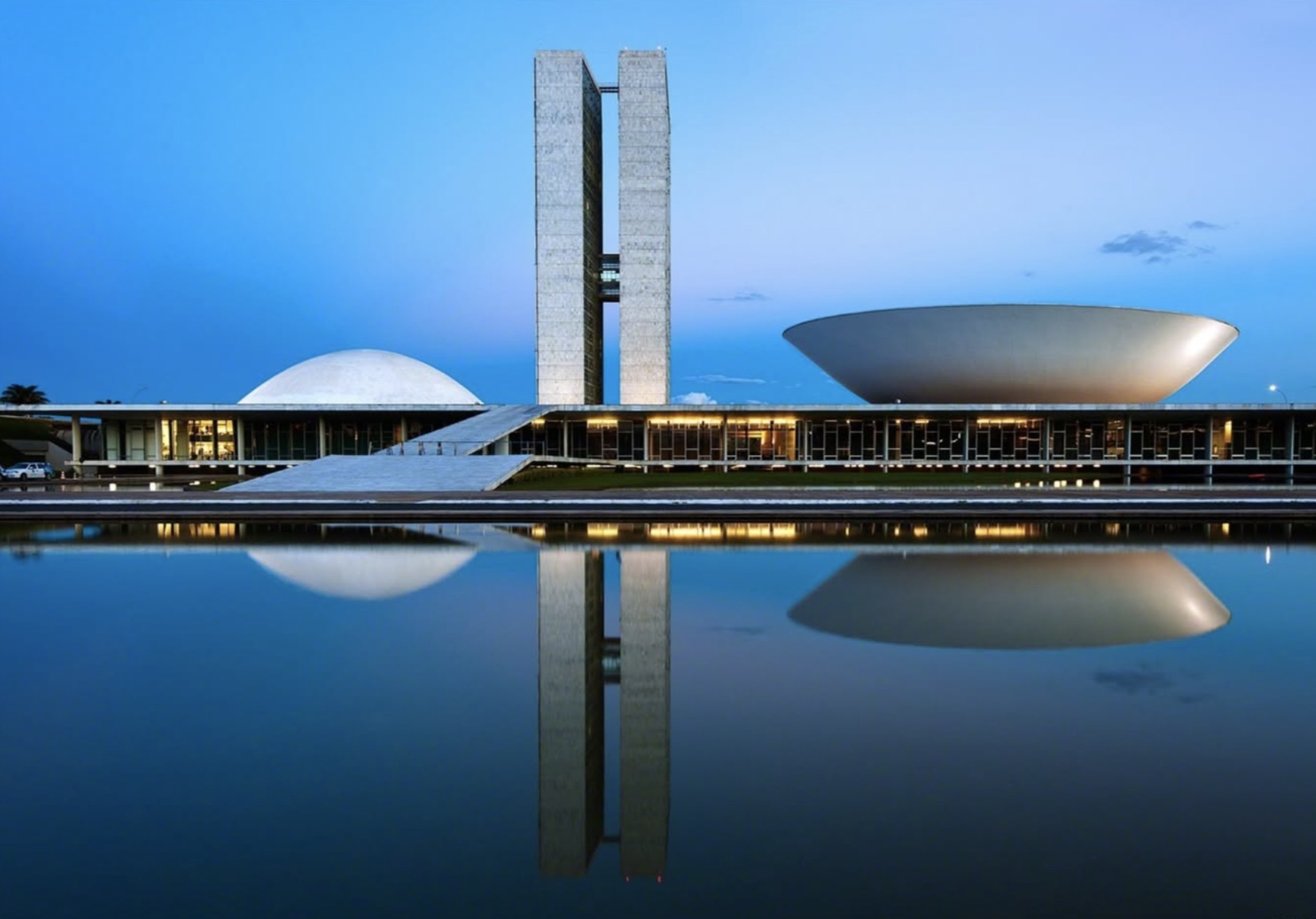
Niemeyer’s most monumental achievement, however, was his role as the chief architect for Brasília, the newly planned capital of Brazil constructed between 1956 and 1960. Working alongside Lúcio Costa (who designed the city’s master plan), Niemeyer designed the city’s crown jewels, including the National Congress of Brazil, the Palácio da Alvorada, and the breathtaking Cathedral of Brasília.
These pristine, futuristic white forms rising from the red earth of the Brazilian highlands cemented his reputation as a master of utopian urban design.
A lifelong communist, Niemeyer was forced into exile in Paris following the 1964 Brazilian military coup. During his time in Europe, he continued to design major projects, such as the French Communist Party Headquarters in Paris. He returned to Brazil in the 1980s after the dictatorship fell and was awarded the prestigious Pritzker Architecture Prize in 1988.
Remarkably, Niemeyer continued working well past his 100th birthday. One of his most iconic late-career masterworks, the Niterói Contemporary Art Museum, was completed when he was 89.
He passed away in 2012 at the age of 104, leaving behind a legacy of over 600 projects worldwide and forever altering the vocabulary of modern architecture.
Active in others filds : Furniture Design (notably the Rio Chaise Lounge and Alta Chair), Urban Planning, Sculpture, and Author/Essayist.