


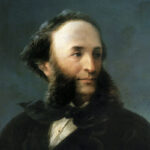

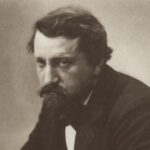

Владимир Евграфович Татлин (Russian) / Володимир Євграфович Татлін (Ukrainian) | Vladimir Yevgrafovich Tatlin (Father: Yevgraf Nikoforovich Tatlin, a railway engineer; Mother: Nadezhda Nikolaevna Bart, a poet)
Vladimir Yevgrafovich Tatlin (1885–1953) was a central figure of the Soviet avant-garde and is widely celebrated as the father of Constructivism. He revolutionized modern sculpture by abandoning traditional carving and modeling in favor of assembling industrial materials, fundamentally changing how art interacted with space and society.
Tatlin’s early life was marked by a rebellious streak; he ran away from home as a teenager to become a merchant marine cadet, sailing to places like Egypt and Turkey. He eventually returned to study art in Moscow and Penza, initially training as an icon painter. His early paintings synthesized the flat, localized colors of traditional Russian religious icons and folk art with the fractured, geometric forms of the emerging Cubo-Futurist movement.
The turning point in his career came in 1914 when he visited Paris and saw Pablo Picasso’s three-dimensional Cubist constructions. Deeply inspired, Tatlin returned to Russia and began creating what he called “counter-reliefs.” These were entirely abstract, three-dimensional assemblages made from wood, metal, and glass. By suspending these works in the corners of rooms, he broke the traditional boundary between the artwork and the viewer’s space, asserting that art should be built from the real materials of the modern, industrialized world.
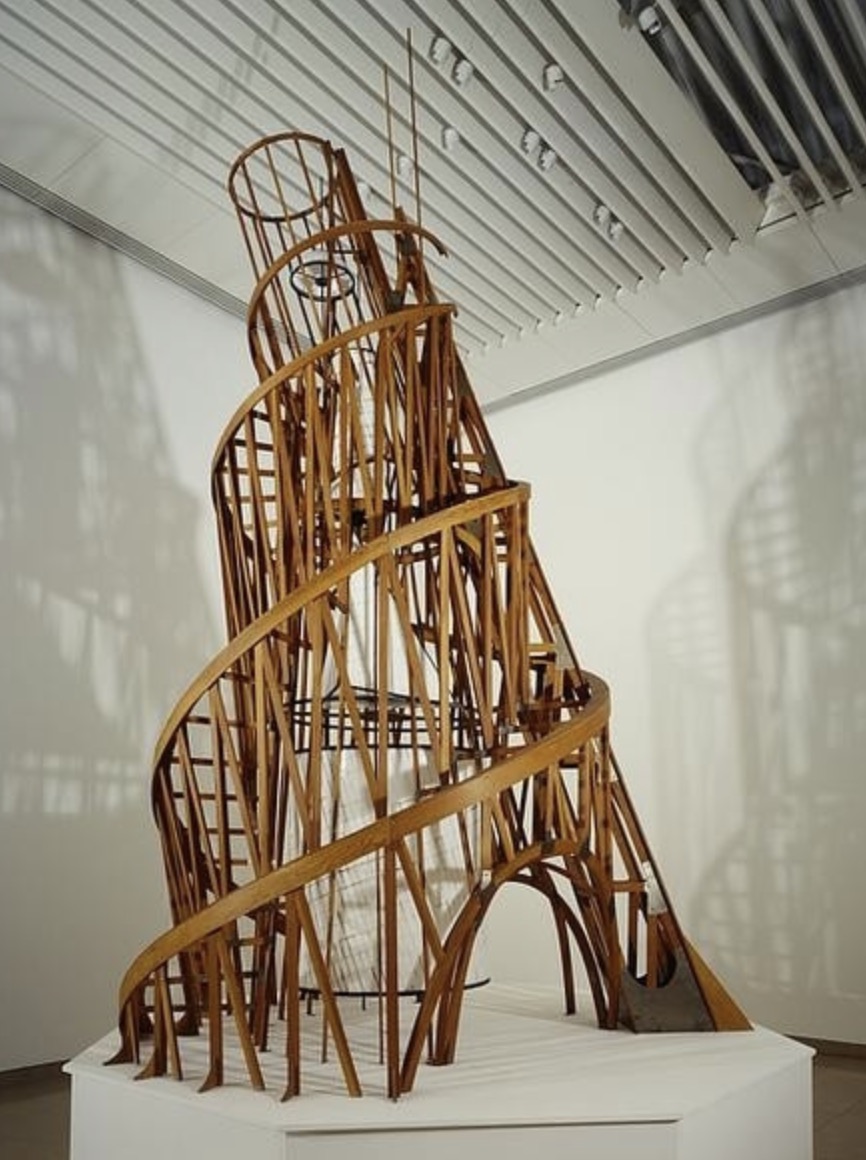
Following the 1917 Russian Revolution, Tatlin and his peers believed that art should serve a practical, social purpose for the new communist state. This philosophy birthed Constructivism. In 1919, he designed his undisputed masterpiece, the Monument to the Third International (often called Tatlin’s Tower). Intended to be taller than the Eiffel Tower, the structure was a spiraling, kinetic framework of iron and glass that would house the branches of the revolutionary government. Though it was never built due to a lack of resources, the model became the ultimate symbol of utopian modernism.
In the 1920s, staying true to Constructivist ideals, Tatlin shifted his focus from fine art to industrial design, creating functional everyday objects like energy-efficient stoves, worker’s clothing, and furniture. In his later years, as the Soviet regime cracked down on the avant-garde in favor of Socialist Realism, he quietly transitioned into theater set design and book illustration, remaining in Moscow until his death in 1953.
Active in others filds : Architecture, Industrial Design (furniture, clothing, tableware), Theater Set and Costume Design, Merchant Marine Sailing.