


The Tête à Tête is the second canvas in the series of six satirical paintings known as Marriage A-la-Mode, painted by William Hogarth.
Read More : Wikipedia

Name : William Hogarth

Born : 1697

Died : 1764

Art Style & Movement : Rococo

Main Field/s :

SUB CATEGORIES
×

Keep Reading About

William Hogarth

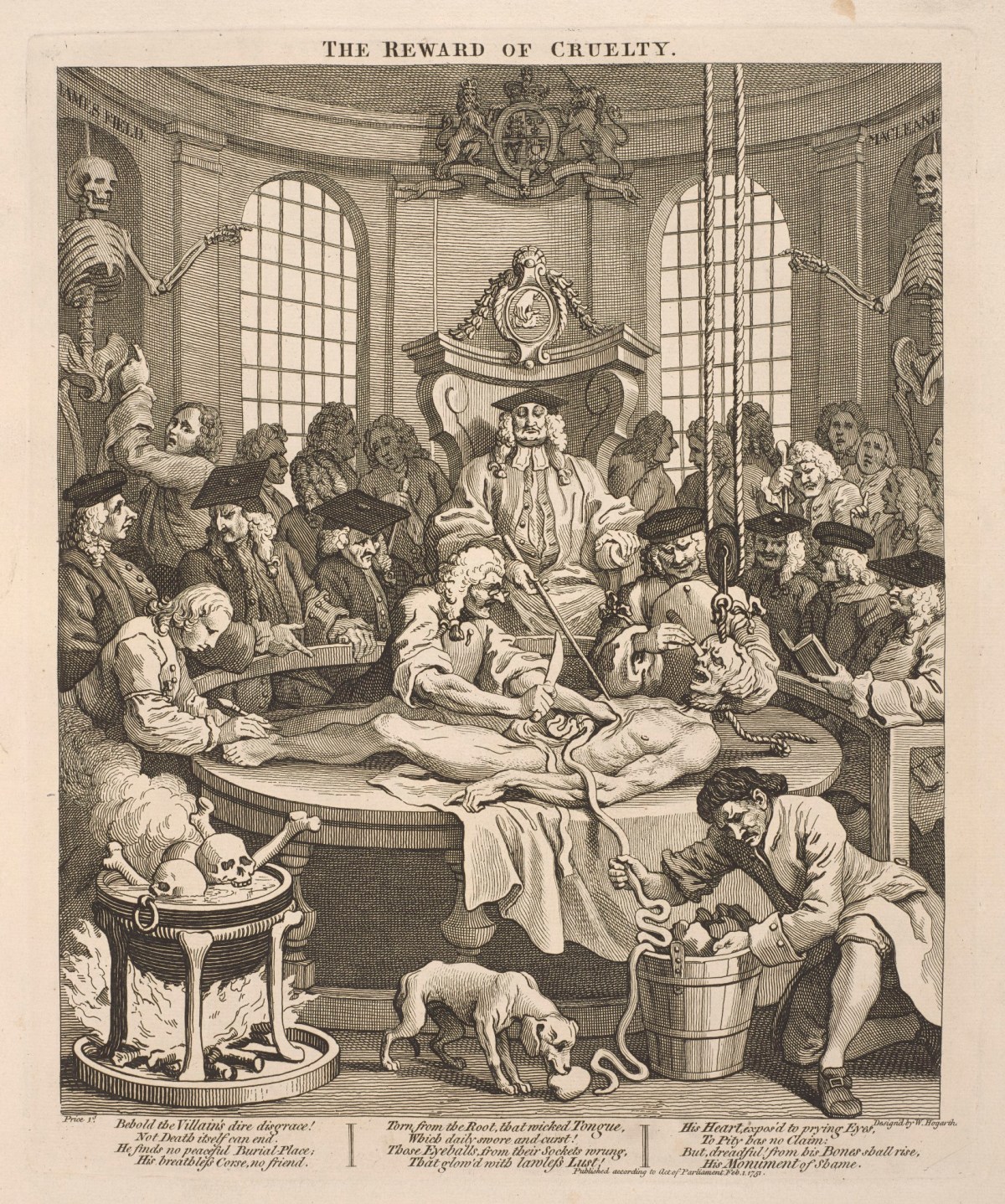
William Hogarth FRSA (/ˈhɡɑːrθ/; 10 November 1697 – 26 October 1764) was an English painter, printmaker, pictorial satiristsocial critic, and editorial cartoonist. His work ranges from realistic portraiture to comic strip-like series of pictures called “modern moral subjects”,[2] and he is perhaps best known for his series A Harlot’s ProgressA Rake’s Progress and Marriage A-la-Mode. Knowledge of his work is so pervasive that satirical political illustrations in this style are often referred to as “Hogarthian”.[3]

Hogarth was born in London to a lower-middle-class family. In his youth he took up an apprenticeship with an engraver, but did not complete the apprenticeship. His father underwent periods of mixed fortune, and was at one time imprisoned in lieu of outstanding debts, an event that is thought to have informed William’s paintings and prints with a hard edge.[4]

Influenced by French and Italian painting and engraving,[5] Hogarth’s works are mostly satirical caricatures, sometimes bawdily sexual,[6] mostly of the first rank of realistic portraiture. They became widely popular and mass-produced via prints in his lifetime, and he was by far the most significant English artist of his generation. Charles Lamb deemed Hogarth’s images to be books, filled with “the teeming, fruitful, suggestive meaning of words. Other pictures we look at; his pictures we read.”[7]
The Realm of Analog Artistry

This curated space is dedicated to the timeless works of global master artists, created through traditional mediums and manual precision. From fine oil paintings to architectural drafting, every piece represents the authentic tactile heritage of visual arts .

William Hogarth

Art by : William Hogarth

Rococo

Cubism represents the most radical break from traditional Western pictorial representation since the Renaissance. Developed primarily in Paris, it abandoned the single-viewpoint perspective that had dominated art for centuries. Instead, Cubist artists analyzed subjects from multiple angles, breaking them into geometric fragments and reassembling them within a shallow, ambiguous space.

For researchers and students, it is essential to distinguish between its two primary phases:

  • Analytic Cubism (1907–1912): Focused on breaking down forms into monochromatic, overlapping planes.

  • Synthetic Cubism (1912–1914): Introduced collage, vibrant colors, and simpler shapes, emphasizing the construction of new forms rather than the deconstruction of existing ones.

Related

Élisabeth Vigée Le Brun
François Boucher
Fragonard
Giovanni Battista Tiepolo
Pompeo Batoni
Francois Lemoyne
SUB CATEGORIES
×

Find Other Master Artists

1378

1455

Shopping Cart

Need Help?

Questions ! Comments ? You Tell Us We Listen .

Feel free to contact us

Add Your Heading Text Here

Login

Shopping Cart