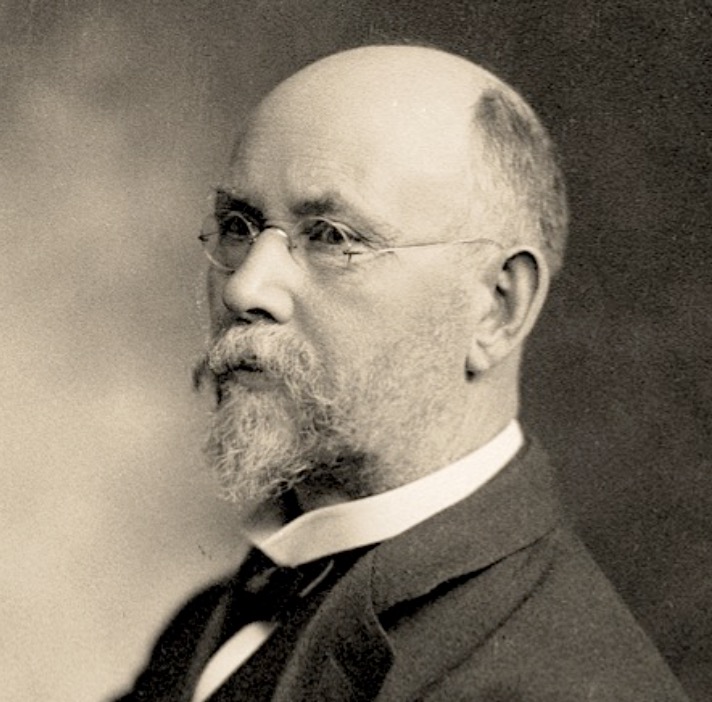
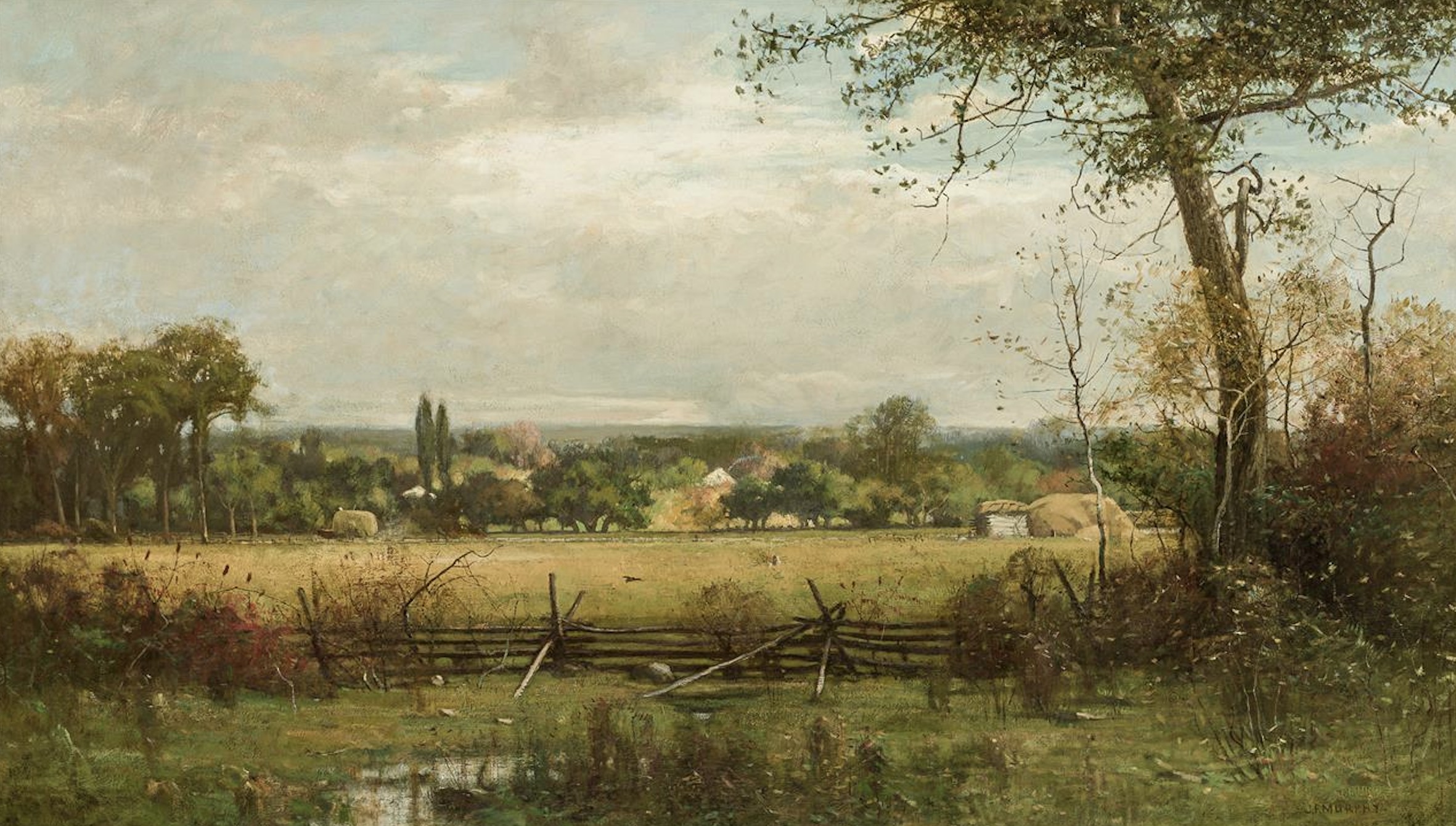
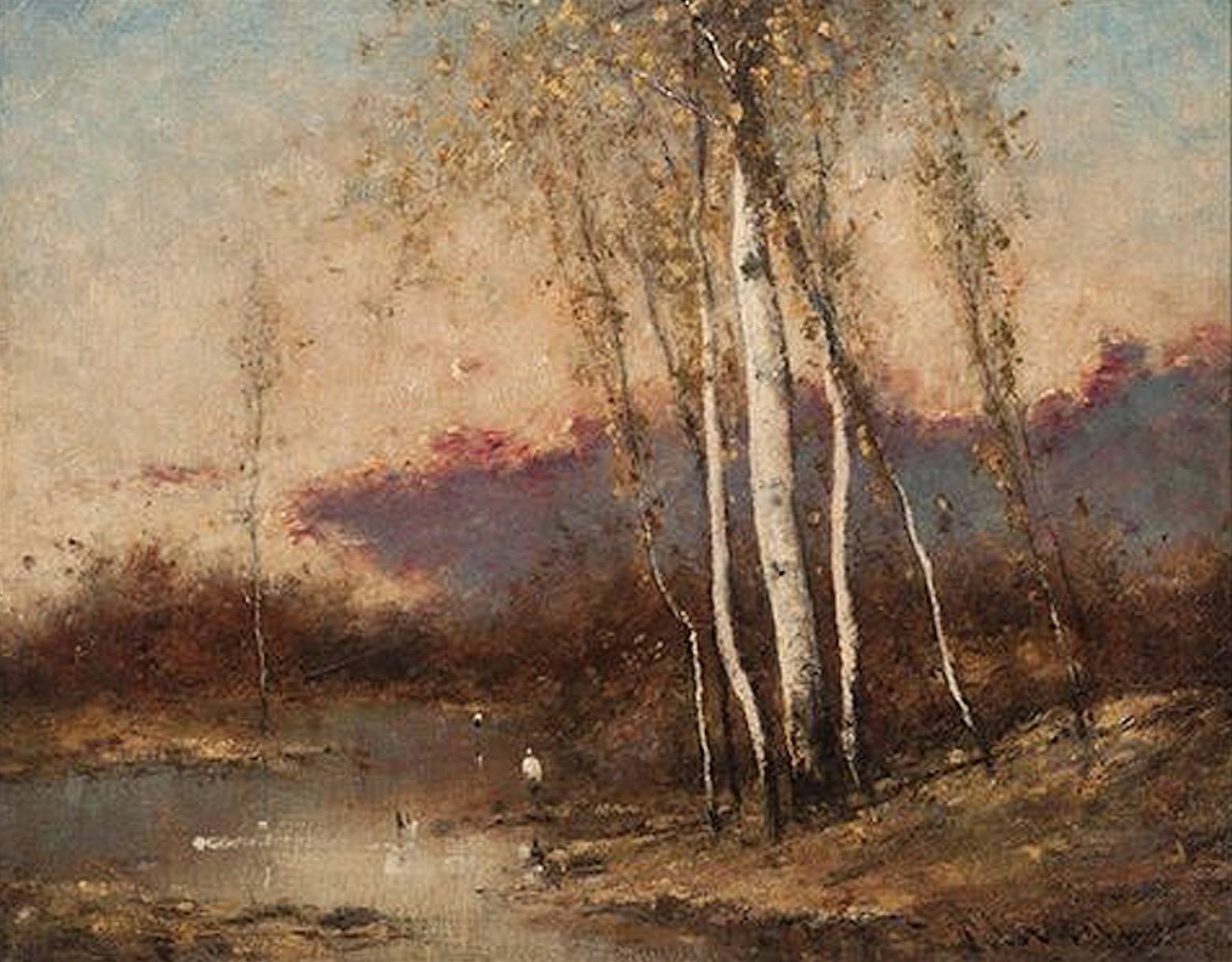
John Francis Murphy (Father: Martin Francis Murphy; Mother: Hannah Gregory; Spouse: Adah Clifford Smith, also a painter) | (1853–1921) was an American landscape painter widely recognized as one of the premier figures of the American Tonalist movement. Often referred to by critics of his era as “the American Corot,” Murphy was celebrated for his poetic, moody, and atmospheric depictions of quiet meadows, barren fields, and autumn twilight.
Born in upstate New York, Murphy moved to Chicago as a teenager, where he found work painting advertising billboards and theater backdrops. He was primarily a self-taught artist, receiving only a few weeks of formal training at the Chicago Academy of Design. In 1874, he moved to New York City to work as an illustrator while struggling to establish himself as a fine artist.
In his early career, Murphy’s work was highly detailed and based on direct observation of nature, heavily influenced by the Hudson River School. However, after a six-month trip to France in 1886 where he studied the French Barbizon painters (like Camille Corot and Théodore Rousseau), and through his subsequent friendship with American painter Alexander Wyant, Murphy’s style shifted dramatically. He moved away from realistic depictions and began painting from memory, focusing on the emotional and lyrical essence of the landscape rather than precise topographical details.
Murphy developed a highly unique and methodical technique to achieve his signature Tonalist atmospheric effects. He would lay down an underpainting of warm browns and golds, flatten it with a palette knife, and let it dry completely. He would then build up the surface by vigorously rubbing it with pumice, adding thick fluid details, lacquering, and applying multiple thin layers of glaze. This created a rich, slightly textured surface that brilliantly captured the subdued light of late afternoons and Indian summers.
By 1900, Murphy had achieved tremendous commercial success and critical acclaim. He spent his winters in New York City and his summers at his home and studio in Arkville, nestled in the Catskill Mountains, drawing endless inspiration from the surrounding terrain. He exhibited frequently at the National Academy of Design (where he became a full academician in 1887) and won numerous prestigious medals at major expositions until his passing in 1921.
Active in others filds : Sign and Billboard Painting (early career), Theater Scenic Design, Commercial Illustration.