Cgitems Logo
Entering
Architectural Movements
Loading Encyclopedia...
Connecting to Cgitems Server...
Thanks for your patience
Architectural Movements - CGItems
☆
  • UK - English UK - English
  • France - Français France - Français
  • Germany - Deutsch Germany - Deutsch
  • Netherlands - Nederlands Netherlands - Nederlands
  • Norway - Norsk Norway - Norsk
  • Denmark - Dansk Denmark - Dansk
  • Finland - Suomi Finland - Suomi
  • Vietnam - Tiếng Việt Vietnam - Tiếng Việt
  • Italy - Italiano Italy - Italiano
  • Sweden - Svenska Sweden - Svenska
  • Brazil - Português Brazil - Português
  • Greece - Ελληνικά Greece - Ελληνικά
  • Thailand - ไทย Thailand - ไทย
  • Iran - فارسی Iran - فارسی
  • Arab - العربية Arab - العربية
  • Spain - Español Spain - Español
  • China - 中文 China - 中文
  • Turkey - Türkçe Turkey - Türkçe
  • Russia - Русский Russia - Русский
  • South Korea - 한국어 South Korea - 한국어
  • Japan - 日本語 Japan - 日本語
  • India - हिन्दी India - हिन्दी

Visual Art Encyclopedia & Galleria

Art Movement , Style & Technique

Architectural Movements

SUB CATEGORIES
×

Architectural Movements

Architectural Movements

A comprehensive guide to the visual principles, history, and pioneers of this movement. Curated for researchers and students seeking a structured analysis of artistic styles & Technique .

Available Art Style & Movement

Select Art Style...
  • Abstract
  • Abstract Expressionism
  • Academic Art
  • Aestheticism
  • Architectural Movements
  • Art Deco
  • Art Nouveau
  • Baroque
  • Bauhaus
  • Byzantine
  • Cartoon
  • CGI
  • Chiaroscuro
  • Chiaroscuro Noir
  • Classical Architecture
  • Classicism
  • Comic
  • Conceptual
  • Contemporary
  • Cubism
  • Dada
  • Early Renaissance
  • Expressionism
  • Fantasy Art
  • Fashion
  • Fashion Design
  • Fashion Illustration
  • Fashion Photography
  • Fauvism
  • Figurative Art
  • Figurative Photography
  • Fresco
  • Gothic
  • Haute Couture
  • High Renaissance
  • Hybrid
  • Illustration
  • Impressionism
  • Landscape
  • Line art
  • Manga
  • Mannerism
  • Marvel
  • Matte Painting
  • Miniature
  • Minimalism
  • Modern Architecture
  • Modernism
  • Muralism
  • Naturalism
  • Neoclassicism
  • Orientalism
  • Photography
  • Pop Art
  • Pre-Raphaelite
  • Realism
  • Regionalism
  • Relief 
  • Renaissance
  • Rococo
  • Romanticism
  • SCI-FI
  • Sculpting
  • Street Art
  • Surrealism
  • Symbolism
  • Tempera
  • Tenebrism
  • Tonalism
  • VFX
  • Victorian

General Specifcations for Architectural Movements

Architectural movements represent the evolution of human civilization through the lens of Form, Function, and Material. Unlike isolated art movements, architecture is bound by the laws of physics and the socio-economic needs of the time. A “Movement” in architecture is defined by a shared vocabulary of structural elements (how it stands up) and aesthetic ornamentation (how it looks).

For the Cgitems database, architectural movements are analyzed through three primary lenses:

  • Structural Innovation: The transition from Post-and-Lintel (Ancient) to Arches/Vaults (Medieval) to Steel Frames (Modern) and finally to Computational/Parametric design.

  • Spatial Philosophy: How a building treats the person inside—from the intimidating “divine scale” of the Gothic era to the “human-centric” ergonomics of Modernism.

  • The Facade & Envelope: The “skin” of the building, which reflects the artistic trends of the era, such as the intricate carvings of the Baroque or the “Glass Curtain Walls” of the International Style.

Related to Architectural Movements

Note : The images below might not strictly correspond to the style and technique of Architectural Movements, but rather represent an artist who also includes this approach in their portfolio.

Richard Rogers

Classification

  • Category: Architecture, Urban Planning, Interior Design, Environmental Design.

  • Era/Period: Prehistoric to Contemporary (Approx. 10,000 BCE – Present).

  • Origin Location: Global (with major historical nodes in Mesopotamia, Greece, Italy, France, and the USA).

Visual & Technical Specs

  • Key Visual Characteristics: Massing (volume), Symmetry vs. Asymmetry, Fenestration (window patterns), and the “Order” of columns or structural supports.

  • Color Palette: Traditionally dictated by local materials (Limestone, Brick, Marble). In the Modern era, defined by the “Truth to Materials” (Grey concrete, Black steel, Clear glass).

  • Mediums & Tools:

    • Historical: Stone masonry, timber framing, lime mortar.

    • Industrial: Reinforced concrete (Béton armé), I-beams, plate glass.

    • Digital: BIM (Building Information Modeling), Rhino/Grasshopper (Parametricism).

Pioneers & Key Works

  • Founders/Key Figures: Vitruvius (Ancient Theory), Andrea Palladio (Renaissance), Le Corbusier (Modernism), Zaha Hadid (Parametricism).

  • Masterpieces:

    1. The Parthenon (Classical perfection).

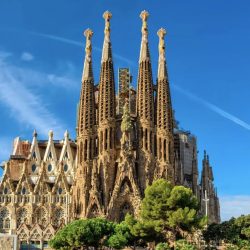
    2. The Sagrada Família (Art Nouveau/Gothic hybrid).

    3. The Villa Savoye (Modernist manifesto).

    4. The Burj Khalifa (Neo-Futurism/Contemporary engineering).

  • Influential Schools: The Bauhaus (Germany), École des Beaux-Arts (France), Vkhutemas (Russia).

Philosophy & Context

  • The “Why”: Architecture is the “Will of an epoch translated into space.” It aims to solve the fundamental conflict between Beauty (Venustas), Utility (Utilitas), and Stability (Firmitas).

  • Historical Context: Movements are usually reactions. Modernism was a reaction to the “clutter” of the 19th century; Post-Modernism was a reaction to the “boring” boxes of Modernism.

Modern Influence: Cinema, TV & CGI

  • 2D, 3D, CGI, VFX: Architecture provides the “Stage” for all visual storytelling. In CGI, “Procedural Architecture” allows for the instant creation of cities (like in Cyberpunk 2077 or Inception). Knowledge of architectural styles is essential for believable Environment Design.

  • Modern Legacy: Digital twin technology and Metaverse “Virtual Architecture” where gravity no longer limits form.

Modern Influence: AI & Hybrid Media

  • Modern Legacy: AI is currently used for “Generative Design,” where an algorithm optimizes a building’s shape for sunlight or wind based on historical style prompts.

  • AI Prompting Keywords: Architectural photography, [Style Name], isometric view, floor plan, brutalist concrete, neoclassical symmetry, parametric curves, photorealistic, Unreal Engine 5 render, global illumination, Ray-traced shadows.

Explore More

Minimalism 1

Some Other Art Styles

Art Styles by random seed

Architectural

Architectural movements represent the evolution of human civilization through the lens of Form, Function, and Material. Unlike isolated art movements, architecture is bound by the laws of physics and the socio-economic needs of the time. A “Movement” in architecture is defined by a shared vocabulary of structural elements (how it stands up) and aesthetic ornamentation (how it looks).

For the Cgitems database, architectural movements are analyzed through three primary lenses:

  • Structural Innovation: The transition from Post-and-Lintel (Ancient) to Arches/Vaults (Medieval) to Steel Frames (Modern) and finally to Computational/Parametric design.

  • Spatial Philosophy: How a building treats the person inside—from the intimidating “divine scale” of the Gothic era to the “human-centric” ergonomics of Modernism.

  • The Facade & Envelope: The “skin” of the building, which reflects the artistic trends of the era, such as the intricate carvings of the Baroque or the “Glass Curtain Walls” of the International Style.

Muralism

Muralism is a monumental, public-facing art movement defined by the creation of massive paintings directly executed on or permanently affixed to architectural surfaces (walls, ceilings, or structural facades). While mural-making dates back to prehistoric caves and Renaissance frescoes, “Modern Muralism”—sparked primarily by the Mexican Mural Movement in the 1920s—transformed the medium into a powerful vehicle for social, political, and historical narrative.

Unlike easel paintings, which are transportable and often treated as private commodities, modern muralism is intrinsically civic and democratic. It was designed to bypass the elite, exclusive spaces of museums and commercial galleries, taking art directly to the working-class public in municipal buildings, schools, and outdoor plazas.

For researchers, students, and CGI artists, Muralism must be understood as an architectural collaborator. A successful muralist does not merely use a wall as a flat canvas; they analyze the architectural volume, viewer sightlines, scale, and environmental lighting of the space.

Muralism Artwork By Diego Rivera,
“Dream of a Sunday Afternoon in Alameda Central Park” (Sueño de una tarde dominical en la Alameda Central) by Diego Rivera, created between 1946 and 1947.

Historically, the movement combined classical European fresco techniques with bold modernist styles like Cubism, Expressionism, and native indigenous folk art aesthetics to create highly legible, heroic, and dynamic visual spectacles.

Marvel

The “Marvel Style” is less a single aesthetic and more an evolutionary lineage of visual storytelling that prioritize dynamic energy, anatomical exaggeration, and emotional relatability. Unlike the “stiff” heroism of earlier eras, the Marvel style—pioneered in the 1960s—introduced characters with flaws, reflected through expressive “acting” in the drawings.

A core technical component is the “Marvel Method”: a collaborative process where the artist (not the writer) plots the visual pacing and action based on a brief synopsis, giving the artist primary control over the “cinematography” of the page. Visually, it is defined by “Kirby Krackle” (clusters of black dots representing cosmic energy), foreshortened limbs that seem to “pop” out of the panel, and high-velocity action lines. From the primary-colored 1960s to the hyper-detailed, painted realism of the 1990s and 2000s, the style consistently balances superheroic scale with human vulnerability.

Orientalism

Orientalism in the visual arts refers to a highly prominent 19th-century movement where Western European painters—primarily from France, Great Britain, Germany, and Austria—depicted the landscapes, cultures, people, and daily life of the Near East, Middle East, and North Africa. Far from a uniform genre, Orientalism operated on a vast spectrum between exacting, scientific ethnography and purely theatrical, romanticized fantasy.

For researchers, students, and art historians, understanding the dual nature of this style is critical:

  • The Realist / Documentary Approach: Artists like David Roberts and John Frederick Lewis traveled extensively, living within the communities they painted. They acted almost as visual archaeologists, documenting Islamic architecture, bustling bazaars, and ancient ruins with remarkable topographic precision. Because sketching crowds openly was often culturally sensitive or forbidden, these artists routinely relied on hidden cameras, clandestine rooftop vantage points, or staged private sittings to achieve hyper-accurate lighting and fabric drapery.

  • The Studio Studio / Fantasy Approach: Conversely, masters like Jean-Auguste-Dominique Ingres never set foot in the East. Instead, they relied heavily on published travelogues, photographs, and studios back in Paris or London that were packed with imported props (such as silks, carpets, hookahs, and weaponry). They created highly polished, Academic Realism scenes of harems, snake charmers, and baths—frequently blending Turkish, Egyptian, and Moroccan motifs into a generalized, exotic construct designed to satisfy Western curiosity and societal desires.

Mannerism

Mannerism (derived from the Italian maniera, meaning “style” or “stylishness”) emerged as a sophisticated, rebellious reaction against the harmonious proportions, symmetry, and ideal beauty of the High Renaissance (epitomized by Leonardo da Vinci, Raphael, and early Michelangelo). Where Renaissance masters sought to mimic nature with realistic perspective and anatomical perfection, Mannerists consciously favored artifice over nature, prioritizing virtuosic technique, intellectual tension, and stylized elegance.

Key stylistic markers for researchers and scholars include:

  • Anatomical Elongation: Human limbs, necks, and torsos are stretched beyond natural anatomical limits to heighten elegance, drama, or emotional tension.

  • The Figura Serpentinata: Figures are contorted into dynamic, corkscrew-like twists, encouraging viewers to look at the artwork from multiple angles rather than a single focal point.

  • Spatial Ambiguity & Compression: Compositions intentionally reject flat-ground vanishing points. Backgrounds feel crowded, shallow, or visually confusing, creating an atmosphere of instability and claustrophobia.

  • Artificial Color Palettes: Ditching atmospheric realism, Mannerists utilized acidic, jarring color schemes (electric pinks, sulfur yellows, pale blues) applied with stark tonal contrasts.

Manga

Manga (漫画) is a sophisticated Japanese sequential art form that evolved from 12th-century scrolls into a global cultural phenomenon. Unlike Western comics, Manga is a multi-generational medium with specific demographic classifications: Shonen (young males), Shojo (young females), Seinen (adult men), and Josei (adult women).

Technically, Manga is defined by its “cinematic” pacing. While Western comics often focus on action-to-action transitions, Manga frequently uses aspect-to-aspect transitions—lingering on a falling leaf or a background detail to establish mood or “Ma” (the interval of empty space). The style relies heavily on a specialized vocabulary of visual symbols, such as “sweat drops” for anxiety or “popping veins” for anger. For researchers, the core of Manga’s power lies in its Iconic Abstraction: characters are drawn with simplified, expressive features (large eyes, minimal noses) to allow the reader to project themselves onto the character more easily.

Reset to Default
+ FAVORITES ✎
✕
⋮ ☆ Architectural Movements
✕
HELP AGENT
PLEASE WAIT, LOADING...
×
MCA

--
Analyzing image & extracting data...

Link Copied!

General Inquiry

Have a question or feedback regarding portfolios? Drop us a line.

Strictly plain English text structure only.

Attachments Inventory

Max 500KB per file. Max 10 images.

Delivery Confirmed

Thank you. Your message and data structural packages have been safely transferred to our desk.

Artist Name Artwork Details
Search with Google Lens
Print...